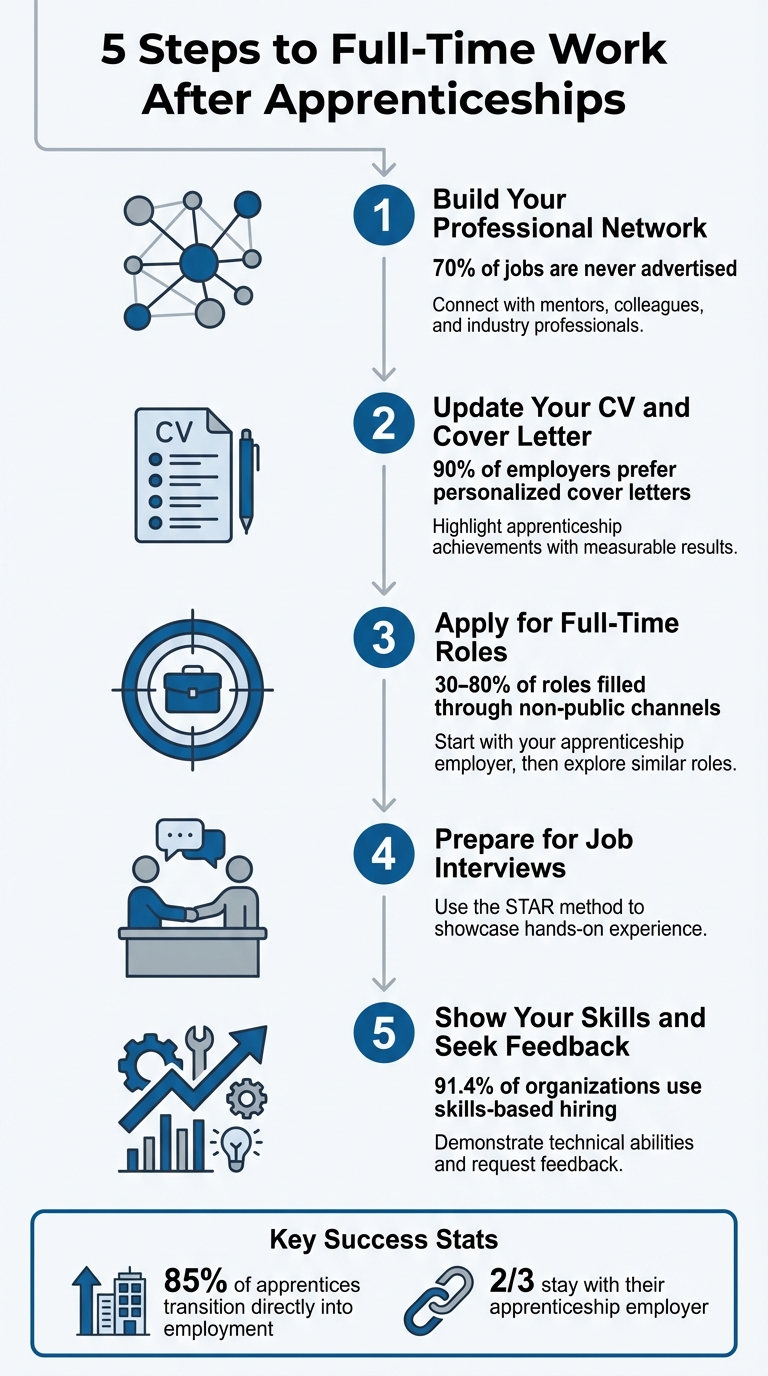
Finished your apprenticeship and wondering what’s next? Moving into full-time work can feel like a big leap, but it doesn’t have to be overwhelming. With the right approach, you can transition smoothly and secure a role that matches your skills and ambitions. Here’s a quick overview of the steps to follow:
- Build Your Professional Network: Connect with mentors, colleagues, and industry professionals. Many jobs (70%) are filled through networking.
- Update Your CV and Cover Letter: Tailor them to highlight your apprenticeship achievements with measurable results.
- Apply for Full-Time Roles: Start with your apprenticeship employer, then explore roles in your field using job boards and company pages.
- Prepare for job interviews: Use the STAR method to structure your answers and showcase your hands-on experience.
- Show Your Skills and Seek Feedback: Demonstrate your technical abilities and ask for feedback to improve.
Key Stats:
- 85% of apprentices transition directly into employment.
- Two-thirds stay with their apprenticeship employer.
- 91.4% of organisations now use skills-based hiring methods.
These steps will help you stand out, whether you’re aiming for a digital marketing role, a data analytics position, or another career in the tech sector. Keep reading for detailed guidance on each step.
5 Steps to Transition from Apprenticeship to Full-Time Employment
What Happens After An Apprenticeship And How To Thrive
sbb-itb-3297dc6
Step 1: Build Your Professional Network
Networking isn’t just about swapping business cards; it’s about forming genuine connections that can open doors to opportunities you might not even know exist. Did you know that 70% of jobs are never advertised? They’re filled through referrals and professional relationships. For apprentices transitioning into full-time roles, your network could be the key to going from countless applications to landing a job offer directly.
Stay Connected with Apprenticeship Contacts
The people you worked with during your apprenticeship – whether they’re colleagues, mentors, trainers, or managers – are some of your most valuable connections. These are the individuals who know your skills and work ethic first-hand, making them excellent advocates for your abilities. After completing your programme, send a thoughtful follow-up message. Reflect on what you learned, express gratitude, and let them know you’d like to stay in touch.
Your mentor, in particular, can be an invaluable guide during this transition. They can offer advice, provide introductions, or even write recommendations. If you haven’t already, consider joining formal networks like the Apprenticeship Ambassador Network (AAN) or the Association of Apprentices (AoA). These organisations connect you with other apprentices and alumni at no cost. Once you’re established in your career, volunteering as a mentor for new apprentices is a fantastic way to give back while also developing your leadership skills.
To expand your network even further, start exploring industry events and online communities.
Join Industry Events and Online Communities
While your apprenticeship contacts form a strong foundation, branching out into broader industry networks can uncover even more opportunities. Attend tech meetups, hackathons, and webinars to meet professionals outside your immediate circle. Organisations like the British Computer Society and the Institute of Engineering and Technology host regular events where you can connect with industry leaders and potential employers.
Don’t forget to make the most of platforms like LinkedIn – but also explore more niche spaces. For example, GitHub is great for collaborating on projects with other developers, while industry-specific forums can be goldmines for job leads and advice. When participating in webinars or events, engage actively – ask questions, share insights, and follow up with speakers afterward. This kind of proactive approach not only leaves a strong impression but also helps you stand out from the crowd.
Finally, ensure your LinkedIn profile and portfolios are up to date. Highlight your apprenticeship achievements so that your connections can clearly see the skills and value you bring to the table.
Step 2: Update Your CV and Cover Letter
Once you’ve built a solid network in Step 1, the next step is to refine your CV and cover letter. These documents are your gateway to potential opportunities, so they need to be polished and purposeful.
Your CV is often your first introduction to an employer, so it should highlight your achievements and the impact you’ve made. Angie Standish, Head of Careers and Employability at the University of Chester, notes that many large employers now rely on Applicant Tracking Systems (ATS) to screen CVs for keywords from job descriptions. In fact, nearly a third of employers use AI in their hiring process. To stand out, ensure your CV is both ATS-friendly and appealing to human recruiters. This dual focus increases your chances of making a strong impression.
Showcase Apprenticeship Achievements
Avoid vague or overused phrases. Instead, use strong action verbs and include measurable results. For instance, rather than saying "Worked on data analysis projects", you could write, "Developed a PowerBI dashboard that enhanced reporting efficiency by 25%." If you’ve managed a marketing campaign during your apprenticeship, specify the outcome, such as "Spearheaded a multi-channel marketing campaign that boosted customer acquisition by 15%."
Organise your apprenticeship experience in reverse chronological order, ensuring your most recent skills and accomplishments are front and centre. Include any relevant certifications, such as Level 3 Digital Marketer or Microsoft Azure credentials, and spell them out in full. These details not only validate your expertise but also align with the keywords employers often look for. Use bullet points to keep your CV clear and concise. The Careers Service Team at the University of Chester suggests limiting your CV to two A4 pages, so choose your content wisely.
Customise Applications for Digital and IT Roles
Research indicates that 90% of employers favour personalised cover letters that show genuine interest. Start by carefully reviewing the job description and mirroring the language used. For example, if the role mentions "data visualisation" or "SEO strategy", be sure to include those exact terms when describing your experience. This strategy not only helps your CV navigate ATS filters but also demonstrates your understanding of the job’s requirements.
For digital and IT roles, include links to relevant professional profiles in your contact details, such as your GitHub portfolio, personal website, or LinkedIn profile. When writing your cover letter, address it to a specific person whenever possible. Explain why you’re drawn to that particular company, referencing a specific project or value that aligns with your interests. Highlight one or two key strengths from your apprenticeship that would benefit the employer. Use the STAR method (Situation, Task, Action, Result) to structure your examples clearly, making it easy for recruiters to see your contributions. Finally, check the job advert for the preferred file format – whether PDF or .docx – before submitting your application.
Step 3: Apply for Full-Time Roles
Now that your CV and cover letter are polished, it’s time to dive into job applications. The key here is quality over quantity – many roles (30%-80%) are filled through non-public channels. A focused, strategic approach will serve you better than sending out countless generic applications.
Approach Your Apprenticeship Employer First
Start by exploring opportunities with your current employer. They already know your skills, work ethic, and how well you fit into the team. Arrange a meeting with your line manager or HR to discuss potential full-time roles. During this conversation, highlight specific contributions you’ve made – perhaps you’ve reduced system downtime, streamlined reporting processes, or played a key role in a successful campaign. Use these examples to demonstrate your value and enthusiasm for growing within the company.
Employers often appreciate when employees take the initiative to discuss their career goals. This conversation could uncover opportunities you weren’t aware of or even lead to a strong referral for roles elsewhere.
Search for Similar Roles in the Digital Economy
If internal opportunities aren’t available, cast your net wider. Look for roles that align with your Level 3 or Level 4 training. The digital apprenticeship service and the Institute for Apprenticeships and Technical Education are great resources for exploring career pathways in fields like Software Development, Data Analysis, and Digital Marketing. Job boards like Total Jobs, Reed, and Monster can give you a good sense of the skills and qualifications employers are seeking.
Make sure your LinkedIn profile stands out. Craft a headline that clearly communicates your value, such as "Data Analyst | Enhancing operational efficiency with SQL and Tableau." Use the "Featured" section to showcase your work – upload a case study PDF, link to your GitHub projects, or share your digital marketing portfolio. And don’t overlook company career pages; while they often attract fewer applicants than larger job boards, they can lead to better hiring outcomes. Applying directly through an employer’s website increases your chances of standing out.
To boost your search, register with NowSkills for access to live digital vacancies and tailored interview preparation. Since January 2026, NowSkills has also offered a Digital Career Goal Planner, which provides personalised roadmaps for skill development. Finally, keep a detailed log of your job applications, including where you’ve applied, the actions you’ve taken, and any follow-up dates. This will help you stay organised and ensure no opportunities are missed.
Step 4: Prepare for Job Interviews
Preparation can make the difference between nailing an interview and missing out. Graduate recruiters want to see that you understand both the role and the organisation inside out, so it’s not enough to skim the basics. Luckily, your apprenticeship has already equipped you with hands-on experience that employers value – you just need to communicate it effectively. Let your apprenticeship stories take centre stage during your responses.
Use Examples from Your Apprenticeship
The STAR method – Situation, Task, Action, Result – is your secret weapon for answering questions clearly and confidently. It keeps your responses focused and ensures you avoid rambling or sounding robotic. For example, if asked about problem-solving, you could describe how you noticed a recurring system error (Situation), were tasked with reducing its impact (Task), introduced a monitoring protocol (Action), and cut incidents by 25% within three months (Result).
"The most important thing to remember about competency-based questions is that your answers must be specific, about a real event that has happened to you personally." – NowSkills
Draw on specific achievements from your apprenticeship to highlight your skills. Did you grow newsletter subscriptions? Simplify reporting processes? Help raise £200 in a fundraising campaign? These examples show your initiative and the results you’ve delivered. Review your CV to predict which accomplishments might come up in the interview. Practise sharing these stories with a friend, focusing on clear delivery and natural body language.
Research Employer Expectations
Dive into the company’s products, market position, and values. Check out their LinkedIn page, recent press releases, and careers section to get a feel for what matters to them. This lets you tailor your STAR examples to their priorities. For instance, if they’re expanding their data analytics team, highlight your apprenticeship experience with tools like SQL or Tableau and explain how it aligns with their goals.
"Research the facts and figures and tell them more about their company than they know themselves! You should know what they do, why they do it, and apply your experience to their business." – NowSkills
Prepare thoughtful questions about their team, current projects, or opportunities for growth. This shows genuine interest and that you’ve done your homework. If things don’t go your way, ask for feedback – it’s a great way to refine your approach for the next opportunity.
Step 5: Show Your Skills and Ask for Feedback
After your interview, it’s time to prove what you can do. Employers are increasingly focusing on skills rather than just qualifications. They want to see how you handle real-world tasks – whether it’s using Python, PowerBI, or SEO tools. This shift towards skills-based hiring is significant; in fact, 91.4% of organisations have shortened their hiring process by incorporating skills tests. Demonstrating your abilities can give you a noticeable advantage.
Demonstrate Your Technical Skills
The best way to stand out is to show, not just tell. If you’re aiming for a digital marketing role, share specific examples – like how you improved email campaign open rates during your apprenticeship. For IT roles, highlight tools you’ve mastered, such as SQL for data analysis or Tableau for creating visualisations. Tailor these examples to the job description by using relevant keywords to align with what the employer is looking for.
A skills summary can be a powerful tool. List the software or tools you’ve worked with, describe the tasks you handled, and quantify the results. For example, if you automated a reporting system and saved your team two hours a week, make sure to mention it. Your apprenticeship has equipped you with practical experience that employers value, which can open the door to more opportunities.
Once you’ve highlighted your skills, the next step is to seek feedback to refine your approach.
Ask for Feedback to Improve
Requesting feedback is a smart move – it shows a willingness to learn and leaves a positive impression. Wait about 24 hours after your interview before reaching out. When you do, focus on specific areas like technical knowledge, your application, or interview performance. Use a clear subject line such as "Feedback Request" and keep your message professional and concise.
"Whether you land the apprenticeship or not, it’s always worth asking for feedback… It shows you’re eager to learn, which is a really great impression to leave behind." – BBC Apprenticeship Partnerships
When you receive feedback, treat it as a chance to grow. If you’re told your technical skills need improvement, set a SMART goal – like earning a certification within two months. For soft skills, consider practising with a mentor or through mock interviews. As Elon Musk wisely notes:
"I think it’s very important to have a feedback loop, where you’re constantly thinking about what you’ve done and how you could be doing it better. I think that’s the single best piece of advice — constantly think about how you could be doing things better and questioning yourself." – Elon Musk, Entrepreneur
What Employers Expect in Full-Time Roles
Understanding what employers look for in full-time employees is crucial when transitioning from an apprenticeship. This shift requires moving from a learning-focused mindset to one centred on delivering tangible results. While apprentices balance assignments, exams, and training hours, full-time employees are expected to demonstrate their skills and actively contribute to business success.
The difference in expectations is noticeable. In a full-time role, the structured support you received as an apprentice fades, and independence takes centre stage. You’ll need to manage your workload, meet business goals, and operate with greater autonomy.
"Those who do choose to stay with the same employer after an apprenticeship will typically make highly skilled, engaged, loyal and productive employees." – Youth Employment UK
Employers also place a premium on advanced problem-solving and critical thinking. During your apprenticeship, mentors and trainers guided your development. In a full-time position, however, you’re expected to take full ownership of your tasks and responsibilities. While support won’t vanish entirely, you’ll need to show initiative and rely less on supervision.
Apprentice vs Full-Time Responsibilities
To prepare for this transition, it’s helpful to understand how responsibilities shift:
| Feature | As an Apprentice | As a Full-Time Employee |
|---|---|---|
| Primary Focus | Learning and gaining practical experience | Delivering results and maintaining competence |
| Assessment | Regular progress reviews and End-Point Assessment (EPA) | Performance reviews tied to business objectives |
| Supervision | Close guidance from mentors and training providers | More independence in managing tasks and projects |
| Compensation | Training-level salary; "earn while you learn" model | Higher salary reflecting qualified status and productivity |
Recognising these differences allows you to better prepare for the increased independence and accountability of full-time work. Before completing your apprenticeship, it’s a good idea to discuss the transition with your employer and training provider. This includes confirming your readiness for the End-Point Assessment and understanding what the next steps will involve. Many organisations offer clear pathways for apprentices to progress into higher-level roles or advanced apprenticeships (Level 4 and above), which can help bridge skill gaps and reduce turnover.
When moving into a full-time role, make sure you receive a new contract that outlines your updated responsibilities and reflects your new status. This marks your growth from an apprentice to a professional ready to make a measurable impact.
Conclusion
Transitioning from apprenticeship to full-time work requires a combination of networking, well-crafted applications, targeted employer engagement, thorough interview preparation, and showcasing your skills with actionable feedback. These steps work together to create a solid foundation, helping you present yourself as a capable professional ready to contribute from day one.
"Preparation is key and will be the deciding factor when it comes to whether you impress the interviewers or not." – NowSkills
Candidates who stand out tailor their CVs, use the STAR method to structure their responses, and demonstrate a strong understanding of their industry. Considering that 72% of recruiters view industry knowledge as ‘very important’, showcasing your expertise can make a significant difference. These efforts ensure you’re well-positioned for a smooth transition into a full-time role.
Expanding your professional network is another crucial component, often revealing job opportunities that aren’t widely advertised. As the BBC highlights:
"Securing a full-time role relies on strategic research, self-promotion, and networking."
NowSkills offers a range of resources to support this journey, including tailored interview preparation, application guidance, and a live vacancy board updated daily. Their dedicated team connects apprentices with employers and provides mentorship to help navigate the shift from training roles to independent positions. By using these resources alongside the outlined steps, you’ll be well-equipped to secure the full-time role you’ve worked towards.
FAQs
How do I turn my apprenticeship work into measurable CV results?
When presenting your apprenticeship achievements, focus on specific contributions, skills gained, and tasks you’ve completed to a high standard. Where possible, use numbers to emphasise your accomplishments – like projects you’ve managed, certifications you’ve earned, or technical skills you’ve mastered.
For instance, highlight moments where you stepped up, such as volunteering for extra responsibilities or helping your team reach shared goals. This shows initiative and a strong work ethic.
Don’t forget to include details about your classroom learning, on-the-job training, or any awards or recognition you’ve received. These examples provide clear, concrete proof of what you’ve achieved and the value you bring.
What should I do if my apprenticeship employer has no full-time vacancies?
If there aren’t any full-time roles available with your current employer, there are still plenty of steps you can take. You could look into further training options, such as higher-level or degree apprenticeships, to build on your existing skills. Alternatively, explore job opportunities with other employers who may value the experience you’ve gained.
Make sure your CV is up to date, showcasing your skills and achievements clearly. Don’t forget to tap into your training provider and professional networks – they can be great resources for finding new opportunities. The skills you’ve developed during your apprenticeship are highly transferable, meaning they could lead to a range of career paths.
How can I prepare for skills tests in digital and IT interviews?
To get ready for skills tests in digital and IT interviews, concentrate on sharpening your technical abilities and getting comfortable with common interview questions. Practising through mock interviews can also boost your confidence. For extra support, NowSkills provides a free interview guide packed with advice on navigating challenging questions, improving body language, and tackling technical assessments. This guide can help you understand what to anticipate and how to excel during your interview.


