
The UK’s AI sector is growing fast, creating thousands of job opportunities. Apprenticeships are now a key way to gain AI skills without university debt. Here’s what you need to know:
- AI Growth: The industry is worth £72.3 billion today and could exceed £800 billion by 2035. Jobs in AI rose by 33% in 2024 alone.
- Higher Earnings: AI-skilled workers earn 21% more on average.
- Government Support: A £725 million package launched in December 2025 aims to create 50,000 new apprenticeships and fully fund training for under-25s at SMEs.
- Pathways: Levels 3–7 apprenticeships cover roles from AI support to advanced data science.
- Free Training: Apprenticeships are fully funded, and you earn while you train.
AI apprenticeships offer a clear route into a booming industry. Whether you’re 16 or looking to switch careers, now is the perfect time to start.
The Digital Advantage – How AI Is Shaping Apprenticeships
Eligibility and Entry Requirements
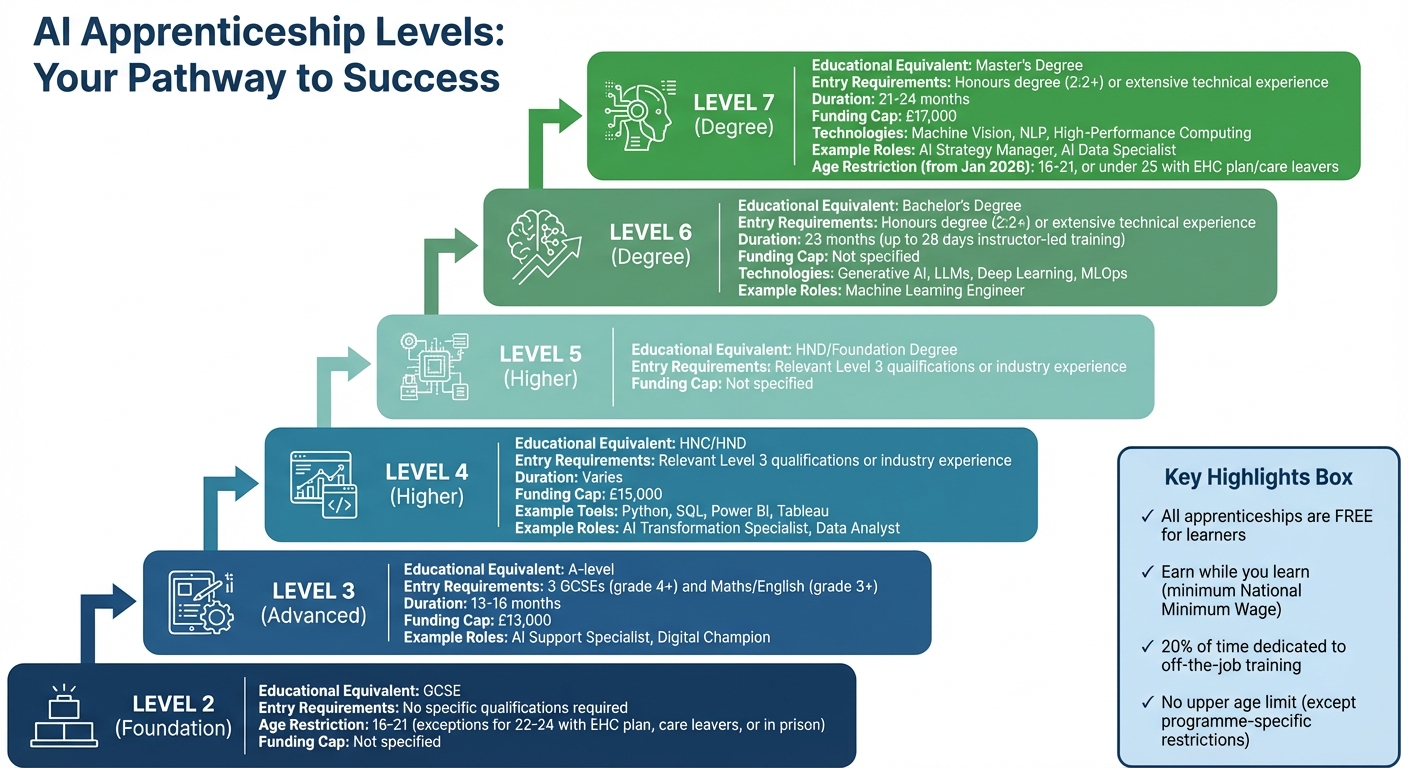
UK AI Apprenticeship Levels: Entry Requirements and Career Pathways 2025
Age, Residency, and Academic Requirements
To apply for an apprenticeship, you need to be at least 16 years old and living in England. There’s no upper age limit, except for certain programme-specific restrictions. However, you can’t be in full-time education when starting your apprenticeship, and you must not already hold a qualification at the same level or higher in a similar subject.
For Level 3 apprenticeships, the typical requirement is three GCSEs at grades 4 or above (A-C), with Maths and English at grade 3 or higher (D or above). If you don’t meet these criteria, you may need to complete Functional Skills qualifications during your apprenticeship. Moving up to Levels 4 and 5, you’ll need relevant Level 3 qualifications or equivalent industry experience. For Levels 6 and 7, an honours degree (2:2 or higher) in a related field is generally required, although substantial work experience can sometimes take the place of formal qualifications.
It’s worth noting that Foundation Apprenticeships (Level 2) are only available to those aged 16–21. Exceptions apply for individuals aged 22–24 if they have an Education, Health and Care (EHC) plan, are care leavers, or are in prison. From 1st January 2026, funding for Level 7 apprenticeships will only be available for individuals aged 16–21, or under 25 if they have an EHC plan or are care leavers.
| Apprenticeship Level | Educational Equivalent | Typical Entry Requirements |
|---|---|---|
| Level 2 (Foundation) | GCSE | No specific qualifications; age 16–21 (exceptions for 22–24) |
| Level 3 (Advanced) | A-level | 3 GCSEs (4+) and Maths/English (3+) |
| Levels 4–5 (Higher) | HNC/HND | Relevant Level 3 qualifications or industry experience |
| Levels 6–7 (Degree) | Bachelor’s/Master’s | Honours degree (2:2+) or extensive technical experience |
Once you understand the eligibility requirements, the next step is to explore why apprentices choose NowSkills and how funding works.
Funding Options for Apprenticeships
One of the biggest advantages of apprenticeships is that they’re completely free for learners. Employers cover the cost of training through the Apprenticeship Levy or government funding schemes. Funding caps vary by programme, with Level 3 apprenticeships capped at £13,000 and Level 7 apprenticeships at £17,000.
If you’re aged 16–24 and a care leaver, you’re eligible for a £3,000 bursary to help ease your transition into work. For small and medium-sized enterprises (SMEs), recent reforms (effective from December 2025) ensure that 100% of training costs for apprentices under 25 are covered, making it easier for smaller businesses to hire apprentices.
Apprentices are also entitled to at least the National Minimum Wage for apprentices if they’re aged 16–18, or 19+ and in the first year of their apprenticeship. Additionally, at least 20% of your working hours must be spent on off-the-job training or study. This ensures you gain both hands-on experience and formal qualifications, balancing practical skills with academic learning.
AI Apprenticeship Levels and Standards
AI apprenticeships in 2025 are designed to align with government policies and industry demands, offering a clear pathway from foundational roles to highly specialised positions. They cover a range of opportunities, from providing basic digital support to contributing to cutting-edge AI research. Each level builds on technical expertise, preparing participants for a variety of careers in the fast-changing world of AI.
Level 3: AI-Integrated Digital Apprenticeships
Level 3 apprenticeships are all about helping organisations embrace AI tools and improve digital efficiency. Participants learn to use technologies like Microsoft Copilot to automate tasks and enhance productivity. These programmes typically run for 13–16 months and come with funding of up to £13,000.
Take Robyn, for example – a Data Citizen Level 3 apprentice at Barnardo’s in 2024. Guided by Remi Martins-Tonk, the organisation’s Head of Data and Insight, Robyn managed to double her productivity. She moved from performing basic Excel analysis to designing Power BI dashboards, enabling her to handle more complex tasks and deliver greater value. Common roles at this level include AI Support Specialist and Digital Champion.
Level 4: Advanced Apprenticeships in AI and Data Analytics
Level 4 apprenticeships take a deeper dive into technical skills, focusing on data manipulation and driving business transformation. Participants gain hands-on experience with tools like Python, SQL, Power BI, and Tableau, while also learning about machine learning fundamentals, stakeholder management, and user-focused design. These programmes are funded up to £15,000.
In 2025, Jonathan Wagstaff, Group Head of Business Intelligence at Exertis, highlighted how his team of data apprentices significantly improved productivity by automating manual spreadsheet tasks. This not only sped up the delivery of business intelligence but also boosted team morale and stakeholder confidence. Organisations using Level 4 apprenticeships have reported impressive results, including £1.4 million in revenue from data-driven insights and a 90% reduction in project timelines thanks to automation.
For those aiming to lead in AI innovation, the next levels offer more advanced, research-oriented training.
Level 6 and 7: Specialised AI and Data Science Roles
Level 6 apprenticeships focus on designing and implementing AI solutions. Participants work with advanced technologies like Generative AI, large language models (LLMs), deep learning, and MLOps. These programmes often include up to 28 days of live instructor-led training over a 23-month period. Entry requirements typically include A-levels in Maths or Technology, or a relevant Level 4/5 qualification.
Level 7 apprenticeships, equivalent to a master’s degree, are geared towards applied research and strategic AI development. Apprentices delve into areas like machine vision, Natural Language Processing (NLP), and high-performance computing, while managing complex datasets. These programmes, funded up to £17,000, usually span 21–24 months.
At the higher levels, apprentices have demonstrated impressive results, such as achieving machine learning model training speeds that are five times faster – highlighting the advanced technical expertise these programmes cultivate.
Government Funding and Policy Updates for 2025
In 2025, the government introduced a £725 million initiative aimed at creating 50,000 apprenticeship opportunities. This move comes as a response to a 40% drop in youth apprenticeship starts since 2015/16. These reforms are part of a broader effort to revitalise apprenticeship programmes and address key challenges.
Key Funding Reforms and Deadlines
One of the most impactful changes for 2025 is the elimination of the 5% co-investment requirement for apprentices under 25 at small and medium-sized enterprises (SMEs). This adjustment means SMEs will now receive full government funding for younger apprentices, removing a significant financial hurdle. Skills Minister Baroness Jacqui Smith highlighted this shift:
"We are making a determined shift of apprenticeship training back towards young people again. We’re fully funding apprenticeship training for young people in small and medium sized businesses, unlike previously."
Additionally, from 1 August 2025, employers offering foundation apprenticeships can claim up to an extra £2,000. For non-levy employers, funds must be reserved through the apprenticeship service at least three months before the apprenticeship start date. These reservations will expire if not confirmed. Levy-paying employers, meanwhile, should be aware that unused funds will continue to expire after 24 months, following a first-in, first-out system. However, they now have the option to transfer up to 50% of unused funds annually to support other employers within their supply chains.
These funding changes align with the government’s broader push to streamline apprenticeship processes, including updates to assessment methods.
Impact of New Policy Changes on Apprenticeships
In addition to funding adjustments, significant changes have been made to how apprenticeships are assessed. The Department for Education has introduced a more flexible "apprenticeship assessment" model, replacing the traditional end-point assessment. This new approach allows for testing throughout the apprenticeship programme, rather than concentrating it solely at the end. Training providers are now permitted to deliver and mark certain assessment components, which helps to cut down on bureaucracy and reduce costs.
Assessment plans have also been simplified, averaging 3–4 pages and focusing exclusively on essential occupational requirements. A notable example is the Level 3 Data Technician (ST0795) standard, which was among the first to adopt a streamlined assessment plan under the revised Skills England framework in 2025. Employers now take a more active role in evaluating apprentices’ behaviours through routine performance management, while training providers concentrate on developing knowledge and skills.
These reforms apply to all apprenticeship programmes starting between 1 August 2025 and 31 July 2026, with a transitional period of 12 to 18 months to allow for full implementation across the sector.
sbb-itb-3297dc6
NowSkills AI Apprenticeship Programmes
NowSkills has designed its AI apprenticeship programmes to translate recent government policies into practical training that meets industry demands. These programmes aim to address the national skills gap by offering qualifications aligned with employer needs and government priorities. Covering Level 3 and Level 4 qualifications, the programmes focus on areas like Content Creation, Digital Marketing, and Data Analytics, ensuring apprentices gain skills that are relevant to the job market.
Level 3 and 4 Apprenticeships Offered by NowSkills
The Content Creator with Artificial Intelligence Tools (Level 3) programme spans 16 months and equips apprentices to use tools such as ChatGPT, Claude, Gemini, Midjourney, and Canva AI to create marketing content, videos, and graphics. This programme operates within a £10,000 funding band and recorded a 71% End Point Assessment (EPA) success rate for 2024–25.
For those interested in marketing, the Multi-Channel Marketer with Artificial Intelligence Tools (Level 3) programme focuses on AI-powered tools like SEMrush for SEO, Hootsuite and Buffer for social media management, and Google and Meta Ads AI for campaign optimisation. This 16-month course is funded within an £11,000 band.
At Level 4, the Data Analyst with PowerBI & Python programme takes 20 months to complete. It includes modules on using Power BI for AI-driven insights, automating repetitive data tasks, and uncovering hidden patterns. Apprentices also gain skills in SQL and Tableau, with opportunities to earn certifications like Microsoft PL-300. This programme achieved a 77% EPA success rate in 2024–25 and operates within a £15,000 funding band.
Each programme combines monthly tutor-led sessions (in-person or online), live virtual classes, on-demand resources, and practical Virtual Labs to provide hands-on experience. Apprentices are required to dedicate at least six hours per week to off-the-job training during paid hours. These elements ensure that apprentices are equipped with skills tailored to both their roles and the needs of their employers.
Employer Partnerships and Upskilling Options
NowSkills screens over 500 applicants monthly to connect apprentices with employers. Their recruitment services are offered at no extra cost, and they also provide options for employers to upskill existing staff through apprenticeship programmes.
"Our Digital Marketing, IT Infrastructure, Content Creation, and Data Analytics apprenticeships are designed in collaboration with employers." – NowSkills
Small and Medium Enterprises (SMEs) in England may qualify for full funding of apprenticeship training costs, while larger, levy-paying employers can use their digital accounts to cover expenses. Employers are also required to assign a workplace mentor to support the apprentice for at least six hours each week.
Monthly Professional Development Reviews (PDRs) bring together the tutor, apprentice, and employer mentor to set goals and track progress. This collaborative approach ensures the training aligns with business objectives while helping apprentices develop practical AI skills.
Support for Apprentices and Career Development
NowSkills provides extensive career support to guide apprentices through their professional journeys. Apprentices work with a Professional Development Plan (PDP) to track their progress and identify areas for growth.
The training includes Masterclass sessions on workplace essentials such as business etiquette, networking, mental health, and resilience. These sessions also cover strategies for staying adaptable in a changing job market. Additionally, the monthly NowSkills Insights webinar series features industry experts who discuss emerging digital trends and AI integration strategies.
Apprentices benefit from access to Virtual Labs, which provide hands-on hardware experience and opportunities to earn additional certifications beyond the apprenticeship programme. To further support career readiness, NowSkills offers application and interview preparation services, ensuring apprentices are well-equipped for their future roles.
Career Outcomes and Industry Demand for AI Skills
Growth in the AI Sector
The rise of AI is reshaping the UK economy in profound ways. Currently, nearly one in six UK organisations has integrated at least one AI tool into their operations, signalling a significant shift towards automation and data-driven decision-making. This shift is expected to drive innovation and boost workplace productivity across a wide range of industries.
AI’s growth isn’t confined to tech companies. The NHS, for example, is striving to become the most AI-enabled health system globally. Other industries, including advanced manufacturing, financial services, and construction, are adopting AI for tasks like predictive maintenance and drone-based surveys. To further strengthen the UK’s AI talent pipeline, major employers such as the BBC, Bank of England, Unilever, and Barclays partnered with Skills England in October 2025 to support the AI Data Specialist Level 7 apprenticeship standard. This collaboration highlights a robust, cross-industry commitment to nurturing AI expertise.
AI apprenticeships are also becoming increasingly attractive with competitive salaries. For instance, Accenture‘s AI Engineer Level 6 apprenticeships in Newcastle upon Tyne and Manchester offer starting wages of £32,028 per year. Similarly, Level 7 AI Data Specialist programmes provide trainees with a salary of £17,000 during their training period. These pay rates reflect the pressing need for professionals who can bridge the gap between AI technology and business operations.
This thriving sector not only fuels economic growth but also creates well-defined career pathways through targeted apprenticeship programmes.
Pathways to High-Demand Roles
AI apprenticeships are paving the way for individuals to step directly into high-demand roles in this rapidly growing field. Entry-level programmes like the AI Adoption Specialist and AI Support Specialist (Level 3) apprenticeships train participants to use tools such as Microsoft Copilot and generative AI platforms across various business functions. These 13–16-month programmes are funded at around £13,000, making them an accessible entry point into the AI workforce.
As apprentices progress to higher levels, the roles become increasingly technical and strategic. Level 4 programmes prepare individuals for positions such as AI Transformation Specialist and Data Analyst. Meanwhile, Level 6 and Level 7 qualifications open doors to advanced roles like Machine Learning Engineer, AI Strategy Manager, and AI Data Specialist. These apprenticeships not only provide essential training but also lead to impactful roles within the industry. For example, apprentices have reportedly generated up to £1.4 million in revenue through data-driven insights, reduced project timelines by 90% with automation, and delivered £120,000 in efficiency savings.
"I’m getting paid to learn something I love to do and I really do feel I could become anything and that the sky’s the limit." – Nodiya Amaeze, Data Analytics Apprentice, NatWest
The skills acquired through AI apprenticeships are highly versatile, enabling career mobility across industries. Whether it’s drug discovery in pharmaceuticals, predictive modelling in media, or advanced analytics in professional services, the competencies gained – from programming languages like Python and SQL to ethical governance and stakeholder management – are applicable across sectors. This broad demand ensures that apprentices completing their training have access to diverse and rewarding career opportunities, far beyond the industries where they initially trained.
How to Apply for an AI Apprenticeship in 2025
Step-by-Step Application Process
The first step is to figure out which apprenticeship level matches your qualifications (as outlined earlier). Once you know what you’re aiming for, head over to the official GOV.UK "Find an Apprenticeship" service to browse live openings. Alternatively, you can register with training providers like NowSkills to access exclusive opportunities and get early alerts about vacancies.
Most applications will require a CV and cover letter. Some providers even offer "Application Packs" to guide you through the process. Use your application to showcase any relevant AI-related projects or hobbies. For instance, have you built a PC from scratch? Do you run a YouTube channel? Have you dabbled with generative AI tools? These examples can really highlight your enthusiasm. If you don’t have formal work experience, don’t worry – focus on initiatives that show resourcefulness, like helping a local business with social media or using AI tools to automate tasks.
"Your application form is your first impression. Make sure it’s clear, enthusiastic, and tailored to the role. Employers aren’t expecting you to be an expert – but they do want to see genuine interest." – NowSkills
To boost your chances, apply for several roles at once. After polishing your application, pay close attention to submission deadlines and any regional specifics.
Key Deadlines and Regional Opportunities
Once your application is ready, timing is everything. Many roles for early 2026 start dates have deadlines between mid-January and late February. For example, Citizens Advice Leicestershire’s IT Support Apprentice role has a deadline of 14th January 2026 for a 21st January start. Meanwhile, National Grid PLC’s Digital Product Management Higher Apprentice position closes on 28th February 2026, with a 1st September start date.
Keep track of these closing dates to gauge when you might hear back from employers. To help manage your applications and search for roles on the go, you can use the "Your Apprenticeship" app. And here’s some good news: apprenticeships are fully funded by the employer and the government, so there’s £0 cost to you as the apprentice.
Conclusion
AI apprenticeships in 2025 offer a debt-free route to a career that’s built to last. Thanks to strong government backing, the journey from Level 3 qualifications all the way to Level 7 (equivalent to a master’s degree) is fully funded and given the same recognition as traditional university pathways. As Prime Minister Keir Starmer put it:
"If you choose an apprenticeship, you should have the same respect and opportunity as everyone else… It’s time to change the way apprenticeships are viewed and to put them on an equal footing with university".
This support is already making a real difference for businesses. Many organisations are reporting measurable benefits from innovations driven by apprentices. For small and medium-sized enterprises (SMEs) hiring apprentices under 25, the removal of the 5% co-investment fee means training new talent is now entirely government-funded.
The "earn while you learn" approach allows you to gain hands-on experience while earning at least the National Minimum Wage. With new AI short courses launching in April 2026 and £140 million allocated to regional mayors to connect young people with local opportunities, the resources for developing AI skills are stronger than ever.
The AI industry is growing at an incredible pace. Head over to the GOV.UK "Find an Apprenticeship" service or sign up with training providers like NowSkills to stay ahead with early notifications. Apprenticeships come at no cost to you and open doors to a fulfilling career in one of the UK’s fastest-growing fields. Take the first step towards securing your future in the booming UK AI sector.
FAQs
What are the advantages of choosing an AI apprenticeship instead of going to university?
Choosing an AI apprenticeship instead of a university degree offers a hands-on and budget-friendly way to break into the tech world. From day one, you’ll earn a salary, gain real-world experience, and work towards a nationally recognised qualification – all without the hefty tuition fees or the burden of student debt that often comes with university education.
One of the biggest perks? Employers usually foot the bill for your training. Apprenticeships blend practical experience with at least 20% off-the-job learning, giving you a mix of hands-on skills and theoretical knowledge. This setup ensures you’re learning exactly what employers need – like how to use advanced AI tools and technologies.
In a rapidly expanding field like AI, apprenticeships can quickly open doors to roles like AI Engineer or Machine Learning Specialist. With the UK experiencing high demand for AI professionals and government-backed schemes promoting apprenticeships, this pathway offers a direct route to a fulfilling career. Plus, you’ll start building your professional network and CV from day one.
How can SMEs access government funding for AI apprenticeships?
Government funding for AI apprenticeships in England offers a fantastic opportunity for small and medium-sized enterprises (SMEs) to access affordable training solutions. Through the Apprenticeship Service, SMEs can have up to 95% of the training and assessment costs covered by the government. Non-levy-paying SMEs are only required to contribute 5% of the total training cost, with the government taking care of the rest. These funds are allocated to the employer’s Apprenticeship Service account and become available once the apprentice completes the necessary off-the-job training hours.
Here’s how SMEs can get started:
- Register on the Apprenticeship Service to set up an account.
- Select an AI apprenticeship standard and confirm the relevant funding band.
- Reserve government funding in their account for the apprenticeship.
- Contribute 5% of the training cost and cover the apprentice’s wages.
- Submit funding claims as needed throughout the programme.
NowSkills provides comprehensive support to SMEs at every step, from navigating the registration process and securing funding to delivering tailored, high-quality training programmes designed to meet specific business requirements.
What career paths can I follow after completing a Level 7 AI apprenticeship?
Completing a Level 7 AI apprenticeship can lead to a variety of career paths in the ever-expanding world of artificial intelligence. You could step into roles like AI Engineer, Machine Learning Engineer, Data Scientist, or AI Researcher. There are also more specialised options, such as Robotics Engineer, AI Ethicist, or AI Data Specialist.
These positions place you at the heart of technological advancements, tackling intricate challenges and shaping innovations in industries like healthcare, finance, and manufacturing. The expertise you gain during your apprenticeship will prepare you to make a meaningful contribution in this fast-evolving field.


