
Want to create an apprenticeship programme that meets your business needs? Here’s a quick guide to building a customised apprenticeship plan that develops the exact skills your organisation requires.
- Customisation matters: Tailored programmes focus on specific technical skills, behaviours, and attitudes to address your organisation’s unique goals.
- Bridge skills gaps: From Digital Marketing to Data Analytics, apprenticeships help close gaps in critical areas, especially in digital fields.
- Government funding: UK businesses can access funding to cover training costs, making it a cost-effective way to upskill staff or recruit new talent.
- Steps to get started:
- Assess your business needs and identify skills gaps.
- Set clear, measurable goals aligned with your strategy.
- Choose the right apprenticeship standards and levels.
- Partner with accredited providers for expert training.
- Monitor progress and evaluate outcomes for continuous improvement.
A well-designed apprenticeship programme not only improves productivity but also prepares your workforce for future challenges. Read on for a step-by-step breakdown.
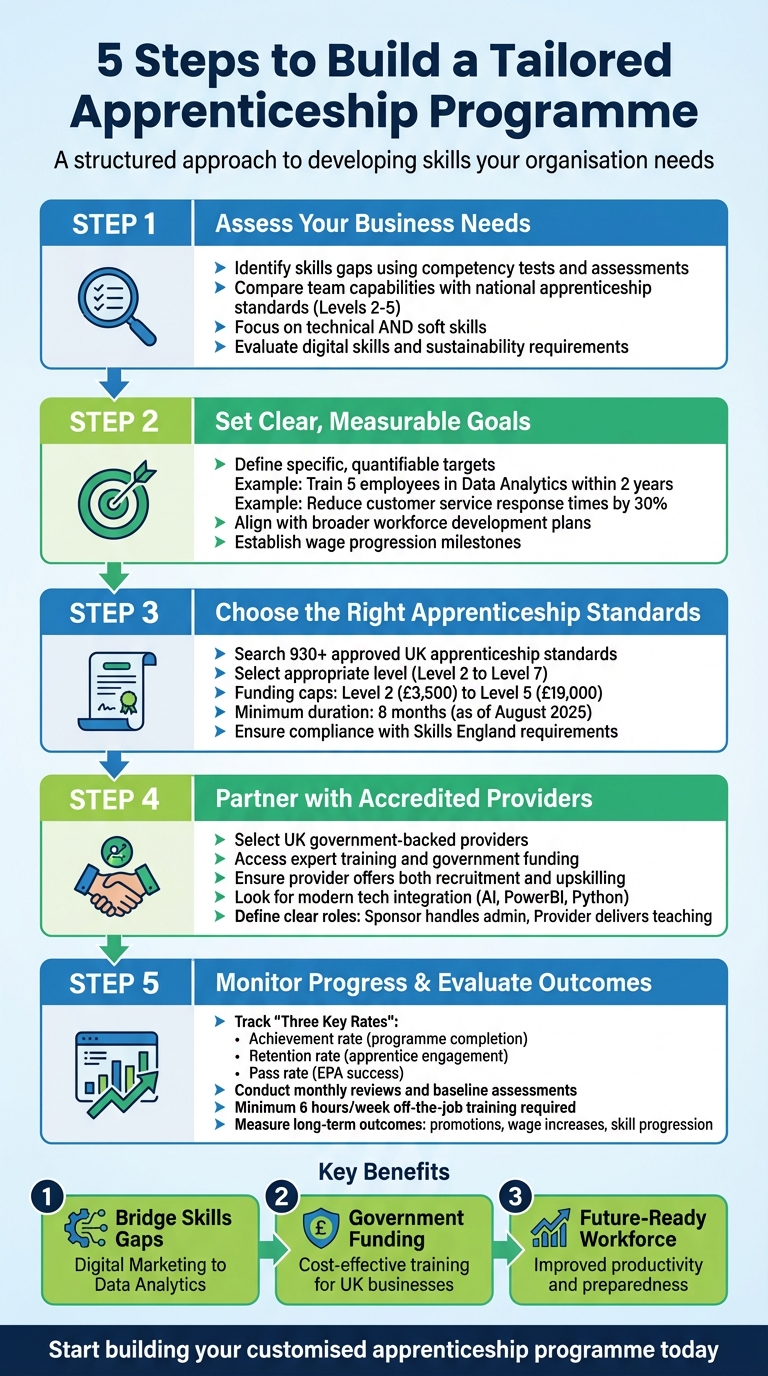
5 Steps to Build a Tailored Apprenticeship Programme
So you want to start a Registered Apprenticeship Program… But How?
sbb-itb-3297dc6
Assessing Your Business Needs and Goals
Before rolling out an apprenticeship programme, take a step back to evaluate your current strengths and align the training with your overall business strategy.
Identifying Skills Gaps
Start by comparing your team’s capabilities with the Knowledge, Skills, and Behaviours (KSBs) outlined in national apprenticeship standards. These standards break down the competencies expected at different levels (from Level 2 to Level 5). For example, a Level 5 standard might require an understanding of data protection laws, expertise in quality control, and familiarity with specific software tools. Match these benchmarks against your team’s current skill set.
To pinpoint gaps, use a mix of methods like competency tests, practical assessments, one-on-one discussions, and focus groups. Don’t just focus on technical skills – soft skills like effective communication, staying calm under pressure, and a strong commitment to quality are equally important.
"Understanding where your organisation stands in relation to industry standards is a critical component of any practical skill gap analysis."
Pay close attention to digital skills. Are your employees comfortable with essential software? Do they understand data protection rules or social media guidelines? In industries undergoing rapid digital change, these gaps can have a big impact. If sustainability is part of your business goals, consider evaluating "green" skills as well – such as sourcing eco-friendly materials or adopting practices that extend product lifecycles.
Once you’ve identified the gaps, the next step is to turn those insights into actionable, measurable objectives.
Setting Measurable Goals
With a clear understanding of your skill gaps, set specific and quantifiable targets. For instance, you might aim to train five employees in Data Analytics using PowerBI and Python within two years, or cut customer service response times by 30% through enhanced IT training.
These goals should align with your broader workforce development plans. If your business is moving towards AI-driven marketing, your apprenticeship programme should prioritise roles like Multi-Channel Marketers with integrated AI training. Establish clear wage progression plans to reward apprentices as they hit key milestones – this not only helps with retention but also shows your dedication to their growth.
Use resources like the UK Skills Taxonomy or industry-specific salary guides to benchmark your goals. This ensures you’re focusing on high-demand skills that will genuinely benefit your business while staying competitive within your sector.
Choosing the Right Apprenticeship Standards
Once you’ve identified the skills your business needs and set measurable goals, the next step is finding an apprenticeship standard that fits. The UK government offers a database with over 930 approved apprenticeship standards, covering industries from Catering and Hospitality to Data Engineering. To get started, use the official "Find apprenticeship training" service to check if a relevant standard already exists for the role you want to develop. This search lays the groundwork for building a tailored programme.
Each standard outlines specific Knowledge, Skills, and Behaviours (KSBs) that apprentices must master to become fully competent in their roles. For instance, if you’re hiring for a digital marketing position, the standard should include skills like SEO, content strategy, and analytics. These standards are designed for flexibility, making them applicable across various businesses within the same industry.
If no existing standard fits your needs, you can create one through a Trailblazer group. This group must include at least 10 employers, with at least two being small businesses (fewer than 50 employees), and is overseen by Skills England. Keep the document concise (no more than three A4 pages in size 12 font) and ensure it includes a clear End-Point Assessment (EPA) plan with well-defined grading criteria.
Selecting Appropriate Levels
Apprenticeships are available at different levels, ranging from Level 2 (entry-level roles) to Level 7 (senior professional positions). The level you choose should reflect the complexity of the job. For example, Level 3 apprenticeships are often suited for "Support" or "Practitioner" roles like Content Creation or HR Support. These may require prior completion of a Level 2 apprenticeship or relevant work experience. On the other hand, Level 4 and higher are designed for more advanced roles, such as Data Analytics or Internal Audit Technician, where apprentices take on greater responsibilities and demonstrate advanced technical skills.
It’s worth noting that funding caps vary depending on the level. For example, Level 2 apprenticeships may have a funding cap of £3,500, while Level 5 can go up to £19,000. Levels 6 and 7 may even include a full degree, often in collaboration with higher education institutions. Additionally, starting from 1 August 2025, the minimum duration for new apprenticeships has been reduced to 8 months, down from the previous 12-month requirement. This change provides more flexibility when designing your programme.
Ensuring Compliance with UK Standards
Once you’ve chosen the right level, it’s essential to ensure that the apprenticeship standard complies with UK regulations. All standards must meet government requirements, with Skills England responsible for their approval, review, and revision. Before launching your programme, confirm the standard has been officially approved and arrange for an independent End-Point Assessment Organisation (EPAO) to oversee the final assessment. This impartial evaluation ensures apprentices meet industry benchmarks.
Each standard must include a clear and detailed EPA, specifying assessment methods and grading criteria. Avoid vague language and instead clearly outline what constitutes a Pass, Merit, or Distinction. If you’re creating a new standard, engage with independent assessment agencies and relevant professional bodies early in the process to ensure the curriculum aligns with industry expectations. Additionally, plan for situations where apprentices may need to retake their EPA by including clear guidelines for re-sits in your programme design.
Designing Core Programme Components
Once you have a compliant apprenticeship standard in place, the next step is to design the core elements of your programme. The aim here is to connect theoretical knowledge with practical application. Start by creating a structured learning plan that outlines the Knowledge, Skills, and Behaviours (KSBs) apprentices need to develop, alongside the training and assessment methods to track their progress. Then, focus on how these components translate into hands-on training and structured evaluations.
On-the-Job Training and Mentorship
On-the-job training is the cornerstone of any apprenticeship programme. It integrates practical, real-world learning into daily tasks under the guidance of an experienced mentor. For example, this could involve troubleshooting IT systems or crafting a social media content strategy.
To make mentorship effective, it’s better to follow a formal structure rather than leaving things to chance. A three-phase mentorship model can provide a clear framework:
- Foundation Phase (Month 1): Start with a workshop to set two or three specific goals for the apprentice.
- Development Phase (Months 2–5): Schedule monthly structured meetings, with a mid-point review to assess progress.
- Evaluation Phase (Month 6): Compare achievements against the initial goals and provide feedback.
Pairing mentors and mentees thoughtfully is key – consider a short chemistry check to ensure compatibility. Additionally, in the UK, apprentices must dedicate at least six hours per week to off-the-job training. This could involve attending workshops, completing online modules, or working on projects that develop new KSBs.
With structured tasks and mentorship in place, it’s important to set clear milestones to monitor progress effectively.
Competency-Based Assessments
Tracking progress requires more than just an annual review. Set specific milestones to evaluate whether apprentices are meeting the KSBs outlined in their standard. Start with a baseline assessment and follow up with regular reviews.
"The assessment methods will differ depending on the apprenticeship standard chosen. There is usually two methods of assessment as a minimum. For example, a multiple-choice test and a professional discussion." – Forum Apprenticeships
Before apprentices attempt the End-Point Assessment, they must pass through a Gateway process. This is a collaborative review between you and the apprentice to confirm all requirements have been met. The Gateway ensures they are ready for their final assessments, which could include professional discussions, multiple-choice tests, or portfolio submissions, depending on the standard. Once through the Gateway, apprentices typically have three months to complete these final evaluations.
Flexibility and Customisation
Every organisation operates differently, so your apprenticeship programme should reflect your unique needs. Decide on the most suitable delivery format – whether in-person, virtual, or hybrid – based on the apprentice’s role and your operational requirements. Collaborate with accredited providers to align the training schedule with your team’s workflows. You can also adapt existing training materials from government databases to include your organisation’s values and priorities, ensuring the programme fits seamlessly with your workplace culture.
Building Partnerships for Programme Delivery
Once the core components of your programme are in place, forming strong partnerships becomes essential for smooth execution. Collaborating with an accredited provider allows you to access expert teaching, leverage government funding, and deliver a curriculum tailored to your organisation’s needs. The key to success is selecting a partner that aligns with your goals and establishing clear roles from the outset.
Partnering with Accredited Providers
Choosing a provider that offers UK government-backed apprenticeships ensures your programme meets national standards and qualifies for funding. Providers like NowSkills specialise in IT and digital apprenticeships, working closely with local employers to deliver programmes that blend classroom learning with practical application. Their offerings, such as Data Analytics, Content Creation, and Multi-Channel Marketing apprenticeships, are developed in collaboration with employers to address real-world business needs.
Look for providers that manage both recruitment and upskilling. For example, NowSkills offers recruitment services at no extra cost and supports the development of existing staff through Continuing Professional Development (CPD). This allows businesses to use apprenticeship funding for levy employers to enhance their current workforce. Modern apprenticeship programmes often incorporate advanced technologies – NowSkills’ Content Creator and Multi-Channel Marketer apprenticeships, for instance, include Artificial Intelligence tools, while their Level 4 Data Analyst programme trains apprentices in PowerBI and Python.
"Our Digital Marketing, IT Infrastructure, Content Creation, and Data Analytics apprenticeships are designed in collaboration with employers." – NowSkills
Assess the governance and quality assurance processes of potential partners. Providers with dedicated Boards of Governors and Quality Assurance teams demonstrate a strong commitment to maintaining high training standards and delivering consistent results.
Defining Roles and Responsibilities
A successful partnership relies on clear definitions of roles and responsibilities, ensuring every aspect of the programme is executed efficiently. The sponsor – typically your organisation – handles administration and operational tasks, while the provider focuses on delivering expert teaching, whether in-person or online. This division of responsibilities supports the practical training and competency assessments that are central to apprenticeship programmes. Internally, your organisation must provide on-the-job learning opportunities, assign mentors, and commit to wage progression as apprentices gain new skills.
Start with an initial knowledge assessment to establish a baseline and customise the training plan. While UK apprenticeship standards provide a solid framework, you can adapt these to fit your specific workflows and organisational needs.
"Apprenticeship required us to rethink our talent strategy – it has to be embedded in what you do, the way you recruit, the way you train – embedded in your business." – Julie Sweet, Chief Executive Officer, Accenture
In 2017, Accenture joined forces with Aon and Zurich North America to create the Chicago Apprentice Network, aimed at helping companies launch their own apprenticeship programmes. By April 2026, this initiative had expanded to include 11 Apprentice Networks, connecting over 225 companies dedicated to advancing careers through skills-focused pathways. This example highlights how well-structured partnerships can amplify impact far beyond a single organisation.
Recruitment, Monitoring, and Evaluation
Once you’ve crafted a tailored programme, the next step is ensuring its success through recruitment, monitoring, and evaluation. This phase connects your training design to measurable recruitment outcomes and ongoing improvements, creating a pipeline of talent that fits your business needs while keeping performance on track.
Tailored Recruitment Strategies
Apprentices are drawn to opportunities that combine expert guidance, hands-on experience, and the ability to earn while they learn. Your recruitment strategy should reflect these priorities. With Gen Z being a digital-first generation, it’s essential to maintain a clear and transparent online presence. Highlight your company culture, diversity efforts, and specific benefits to make your organisation appealing. Avoid vague phrases like "competitive salary" in job ads, as many apprentices may not understand this. Instead, provide clear salary details and outline the recruitment timeline to manage expectations.
When interviewing, focus on enthusiasm for the industry and transferable skills rather than prior work experience, which many apprentices may lack. Psychometric testing can also help identify candidates who are likely to thrive in your organisation and grow within the programme. Keep the lines of communication open with all applicants, whether they are successful or not, to protect and enhance your employer brand. Once you’ve chosen a candidate, celebrate their success and provide them with resources and a point of contact to help them transition smoothly into their new role.
These recruitment practices lay the groundwork for effective progress tracking and evaluation, as discussed below.
Performance Tracking and Metrics
To track performance effectively, start with initial assessments and continue with regular reviews. Use a mix of practical exercises, formal testing, and structured on-the-job training to measure progress. Monthly reviews of data ensure that completion statuses and achievement dates in the Individualised Learner Record (ILR) are accurate, avoiding errors that could negatively impact achievement rates.
Evaluating Programme Outcomes
Programme success isn’t just about completion rates – it’s about understanding the bigger picture. The "Three Key Rates" diagnostic is a valuable tool for spotting challenges.
- Achievement rate: Reflects overall programme effectiveness (e.g., a 75% rate means 75 out of 100 apprentices complete the programme).
- Retention rate: Indicates whether the training environment is supportive enough to keep apprentices engaged.
- Pass rate: Measures how well apprentices are prepared for their End-Point Assessments (EPAs).
These metrics are not just internal – they are shared with Ofsted and directly affect provider grades and funding.
Dig deeper into the data to identify when apprentices leave the programme. Early withdrawals often point to issues with initial assessments or mismatched expectations during recruitment. If apprentices leave mid-programme, it might signal workplace challenges or strained relationships with line managers. Late-stage withdrawals are often linked to EPA stress or personal circumstances. If pass rates are low, consider increasing mock assessments to build confidence and address knowledge gaps earlier.
Finally, track what happens after the programme. Look at indicators like wage increases, promotions, or progression to higher-level training. These outcomes provide a clear picture of the programme’s long-term impact and success.
Conclusion
Designing a customised apprenticeship programme requires careful planning and attention to detail. From assessing your organisation’s needs to selecting the right standards, creating adaptable training plans, and tracking progress, every step plays a role in bridging skills gaps and preparing your workforce for the demands of the digital age.
Government-funded apprenticeships offer a practical way to attract fresh talent and develop the skills of your current employees. By working with accredited providers who understand your industry’s needs, you can ensure the training combines expert knowledge with practical application, all while making the most of available funding.
"Apprenticeships build new talent for your business – with funding available to help pay for the training costs." – Apprenticeships.gov.uk
Since 2013, NowSkills has partnered with UK employers to deliver IT apprenticeships, helping hundreds of individuals progress into senior roles within the digital sector. This blend of funding opportunities, expert support, and clearly defined roles creates the foundation for a workforce equipped to meet future challenges.
Whether you’re looking to recruit new digital talent without recruitment fees or enhance the skills of your current team, a thoughtfully designed apprenticeship programme offers measurable benefits over the long term. Start by setting clear objectives, working closely with your chosen provider, and consistently monitoring progress to build a workforce ready for tomorrow.
FAQs
How do I choose the right apprenticeship level for a role?
Choosing the right apprenticeship level hinges on the complexity of the role, its responsibilities, and the candidate’s existing skills and qualifications. Apprenticeships span from Level 2 (comparable to GCSEs) to Levels 6 and 7, which are equivalent to degree-level qualifications. For entry-level roles, Level 2 or Level 3 may be appropriate. However, more specialised positions, such as Software Developer or Network Engineer, typically align with Level 4. It’s important to match the apprenticeship level to both the job’s requirements and the apprentice’s growth objectives.
What counts as off-the-job training in the UK?
Off-the-job training is a legal requirement for apprenticeships in the UK, making up at least 20% of an apprentice’s working hours. This type of training involves activities such as formal sessions, workshops, and e-learning, all aimed at building the skills, knowledge, and behaviours needed for the apprenticeship. However, it’s important to note that routine work tasks without any added training do not count towards this time. Crucially, this training happens during regular working hours and is considered protected time specifically dedicated to learning.
How do I use government funding for apprenticeships?
Employers looking to tap into government funding for apprenticeships need to set up and manage an apprenticeship account on the apprenticeship service via GOV.UK. This process involves creating an account, ensuring you have a PAYE scheme reference (if required), and agreeing to the employer terms set out by the Department for Education.
The funding provided is designed to help with training costs. To make the most of it, ensure you stay updated on current policies, pick a course that aligns with your needs, select a trusted training provider, and plan thoroughly for the end-point assessments.


