
The Apprenticeship Levy is a UK funding initiative designed to help businesses train employees through government-supported apprenticeship programmes. If your annual pay bill exceeds £3 million, you contribute 0.5% of your payroll to this levy, which can be used for training both new hires and current staff. Smaller businesses (under £3 million payroll) receive 95% government funding for apprenticeship costs, paying only 5% themselves.
Key points to maximise your levy funds:
- Funds expire after 24 months if unused.
- Apprenticeships can train employees of all ages, from GCSE to Master’s-level qualifications.
- Conduct a skills gap analysis to identify training priorities.
- Align skills gaps with government-approved apprenticeship standards.
- Use the Apprenticeship Service Portal to manage funds, select training providers, and track progress.
- Plan for upcoming changes like shorter apprenticeships (8 months minimum from August 2025) and revised funding rules.
Focusing on high-demand areas like digital and IT skills, such as data analytics or cybersecurity, can address workforce shortages while improving retention and productivity. Proper planning, tracking, and collaboration with accredited providers ensure your levy investment delivers measurable results for your business.
Apprenticeship Levy Explained
Eligibility and Funding Rules
Understanding how the Apprenticeship Levy works is crucial for making informed decisions about workforce development. The funding system varies depending on the size of your organisation, offering tailored benefits for both large employers and smaller businesses.
Who Pays the Apprenticeship Levy?
The Apprenticeship Levy applies to businesses and charities with an annual pay bill of £3 million or more, which typically includes organisations with around 100 employees.
If your organisation falls into this category, you’ll contribute 0.5% of your annual pay bill to the levy. However, thanks to a £15,000 annual allowance, you’ll only pay on the amount exceeding £3 million. To calculate your monthly contribution, take 0.5% of your annual payroll, subtract the £15,000 allowance, and divide the remainder by 12. The levy is automatically collected through your PAYE submissions.
Funding Options for Levy and Non-Levy Payers
The funding system offers two distinct routes, depending on whether you pay the levy or not:
- Levy-paying employers: Funds in your levy account can be used to fully cover apprenticeship training costs, accessed through your Apprenticeship Service account. However, these funds must be spent within 24 months.
- Non-levy paying employers: If your organisation doesn’t meet the £3 million threshold, you’ll benefit from a co-funding arrangement. Under this scheme, you contribute just 5% of the apprenticeship training costs, while the government covers the remaining 95%.
| Employer Type | Annual Pay Bill | Employer Contribution | Government Contribution | Fund Expiry |
|---|---|---|---|---|
| Levy Payers | Over £3 million | 0.5% of payroll (minus £15,000 allowance) | None (uses own levy pot) | 24 months |
| Non-Levy Payers | Under £3 million | 5% of training costs | 95% of training costs | N/A |
These funding pathways provide flexibility for organisations to invest in professional development while adhering to the specific rules outlined below.
Key Rules for Using Levy Funds
To make the most of your levy funds, it’s essential to follow these guidelines:
- Levy funds must be used within 24 months and can only be spent on government-approved apprenticeship training programmes.
- Apprenticeships are open to individuals of all ages, and current employees can participate without any reduction in their salary.
- There’s a wide range of qualifications available, with over 600 options, spanning from GCSE-level training to Masters Degrees. This includes specialised programmes like the Level 7 Senior Leaders course, tailored for executives, senior managers, and leadership teams.
- Graduates are also eligible for apprenticeships, ensuring development opportunities are accessible at every level within your organisation.
It’s important to remember that apprenticeship training should align with your business goals rather than being used simply to spend your levy funds. The levy pot is specifically allocated for apprenticeship training, offering a cost-effective way to enhance your team’s skills and drive organisational growth.
Identifying Workforce Skills Gaps
Before allocating levy funds, it’s crucial to pinpoint your organisation’s skill shortages. A well-executed skills gap analysis ensures your training investments yield tangible benefits instead of merely using up available funds.
Conduct a Skills Gap Analysis
A skills gap analysis compares the current capabilities of your workforce with the skills needed to achieve your business goals and prepare for future growth. This process helps you focus your levy funds on areas that will have the greatest impact.
Begin by outlining your business objectives and identifying the digital and IT skills necessary to meet them. Think about both immediate operational requirements and the future technological changes that could influence your industry. From April 2025, the Growth and Skills Levy will offer more flexible funding options, making it even more important to align your training plans with business needs.
To assess workforce skills, use a combination of self-assessments, manager feedback, performance reviews, and formal skills audits. Collaborate with department heads and team leaders to validate your findings and gain insights into how skill gaps affect daily operations, customer service, and project outcomes. These stakeholders often have the best understanding of the practical challenges caused by missing skills.
Don’t ignore external factors like industry trends or advances in technology that may require new skill sets.
Once you’ve gathered your data, document your findings and rank the identified skills gaps based on urgency, potential impact on business performance, and alignment with available apprenticeship standards. This prioritisation will guide you in deciding which training programmes to implement first. With these gaps clearly defined, the next step is to map them directly to relevant apprenticeship standards.
Match Skills Gaps with Apprenticeship Standards
After identifying the gaps, connect them with suitable apprenticeship standards and programmes. The Institute for Apprenticeships and Technical Education offers over 650 apprenticeship types across various levels and sectors, providing a wide range of options to address workforce development needs.
For instance, common digital and IT skills gaps often include areas like data analytics, IT infrastructure, cybersecurity, digital marketing, software development, content creation, and cloud computing. Each of these aligns with specific apprenticeship standards.
Providers like NowSkills offer tailored programmes such as the Data Analyst with PowerBI & Python (Level 4) Apprenticeship or the Content Creator with Artificial Intelligence Tools (Level 3) Apprenticeship, which directly address gaps in data analytics and content creation.
When choosing apprenticeship levels, consider the complexity of the skills gap. Level 3 apprenticeships (equivalent to A‑levels) are ideal for intermediate roles, while Level 6 apprenticeships are designed for professional roles requiring deeper expertise. Keep in mind that from January 2026, Level 7 apprenticeships will no longer be funded through levy contributions, so plan ahead if your organisation requires these advanced qualifications.
The Growth and Skills Levy will also introduce shorter apprenticeship durations, with a minimum of 8 months instead of 12, starting in August 2025. This change offers greater flexibility, especially for addressing urgent skills gaps.
When prioritising multiple gaps, assess their impact on business operations. Focus on those that most significantly affect efficiency, revenue, or competitive positioning. Some gaps, such as those related to regulatory compliance or critical business functions, may require immediate attention. From April 2025, remember that 50% of levy funds must go towards apprenticeships, while the other 50% can support other approved training initiatives.
Partner with accredited training providers who work closely with employers to design relevant programmes. These collaborations ensure that apprenticeship content addresses your specific skills gaps while meeting industry and regulatory standards.
Choosing and Planning Apprenticeship Programmes
Once you’ve pinpointed your skills gaps and aligned them with relevant apprenticeship standards, the next step is selecting the right programmes and planning their delivery. This process ensures your apprenticeship levy is put to effective use, setting the stage for a successful implementation.
Selecting Accredited Programmes
After identifying the areas where your organisation needs skilled talent, it’s crucial to choose accredited programmes that align with those needs. The programmes you select must be listed on the approved apprenticeship standards and delivered by a government-approved provider. This guarantees both quality and eligibility for levy funding.
When evaluating providers, focus on their ability to design programmes tailored to industry demands. For example, NowSkills offers accredited programmes that combine expert instruction with hands-on experience, addressing the real-world challenges faced by businesses.
If your organisation is undergoing digital transformation, specialised apprenticeships such as the Data Analyst with PowerBI & Python (Level 4) or the Content Creator with Artificial Intelligence Tools (Level 3) could be a perfect fit. These programmes are designed to tackle skills shortages in high-demand areas, helping businesses secure the talent they need.
It’s also essential to assess the provider’s governance and quality assurance practices. Look for a proven track record and positive employer feedback. For instance, a UK government survey in 2023 revealed that 86% of employers found apprenticeships helped them build relevant skills, while 78% reported increased productivity as a result. Providers like NowSkills, which hold a 4.7/5 rating on Trustindex, are often praised for their communication, course details, and ability to deliver results.
Additionally, check whether the provider offers extra support services beyond training. Providers that assist with funding, offer employer guidance, and provide career support to apprentices can significantly boost the programme’s success and retention rates.
Planning for Effective Delivery
Once you’ve chosen the right programme, effective delivery is the next step. This requires thorough planning to meet legal obligations, coordinate schedules, and integrate the apprenticeship into workplace operations.
Start by ensuring all legal documentation is in place, including signed apprenticeship agreements and individual training plans. If this is your first time employing apprentices, consider running a pilot scheme with a small group to test the process.
Set clear and achievable objectives for the pilot. Discuss these goals with the apprentice at the outset and review them regularly to track progress and maintain engagement.
Carefully plan the balance between off-the-job training and workplace learning. Apprentices are required to spend at least six hours per week on off-the-job training, with the rest of their time dedicated to practical work. Schedule this training in advance and anticipate any potential conflicts with work commitments, helping apprentices adjust as needed.
Ensure that workplace tasks align with the training programme’s content. A clear understanding of the apprenticeship standard will help you identify opportunities within your organisation for apprentices to apply their learning and prepare for their End Point Assessment.
Regular check-ins with your training provider are vital for monitoring progress, addressing challenges, and keeping the programme on track. Apprenticeships must last at least one year, though some may require longer depending on the standard and the apprentice’s prior learning.
Speaking of prior learning, take the apprentice’s existing knowledge and experience into account when planning their training. Recognising what they already know can reduce the programme’s length and cost, making more efficient use of your levy funds. This assessment should be done before finalising contracts and training plans.
Lastly, assign a mentor or line manager to each apprentice. This person should understand the apprenticeship standard and provide meaningful opportunities for the apprentice to apply their training. A motivated apprentice who actively looks for ways to integrate their learning into their work is a strong indicator of progress in the right direction.
sbb-itb-3297dc6
Registering and Managing Levy Funds
To make the most of your apprenticeship levy funds, start by registering on the Apprenticeship Service Portal. This platform allows you to manage your funds, track contributions, and formalise agreements with training providers, ensuring compliance and smooth programme delivery.
Accessing the Apprenticeship Service Portal
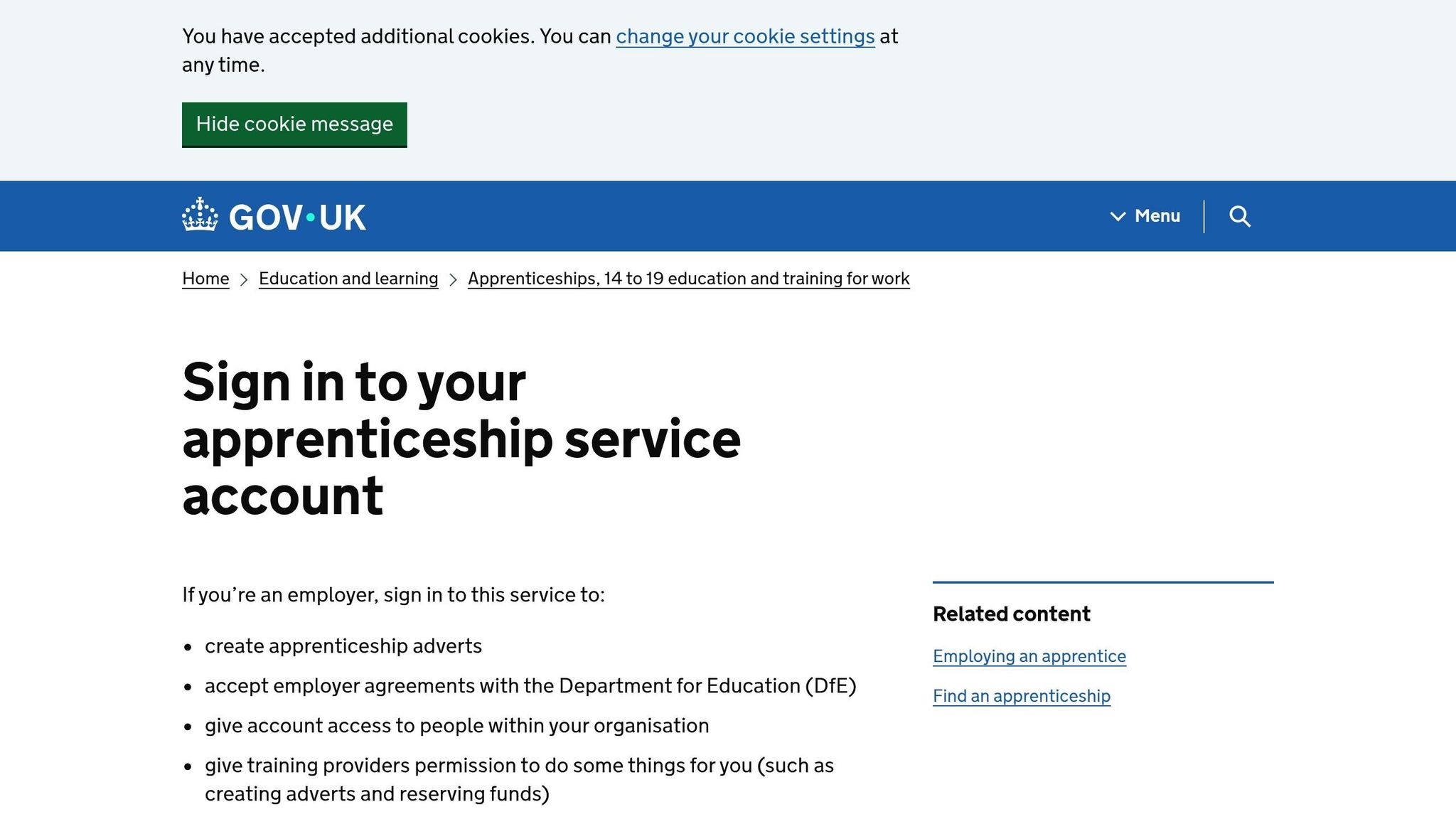
The Apprenticeship Service Portal is your go-to tool for overseeing apprenticeship funding and arrangements. Before you can allocate funds or approve training agreements, you’ll need to register and familiarise yourself with its features.
To register, use your PAYE scheme reference along with your Government Gateway credentials. Once linked, the portal will automatically track your levy contributions, displaying them as credits in your digital account. This real-time tracking gives you a clear view of your funds, including monthly contributions, committed expenditures, and any amounts at risk of expiring. The dashboard is particularly helpful for monitoring these details, ensuring you can act before funds expire.
If your business has a pay bill under £3 million, you can access co-investment funding through the portal. Under this arrangement, the government covers 95% of training costs, leaving you responsible for just 5%. This makes apprenticeship programmes accessible even for smaller employers.
The portal also helps you find approved training providers that meet specific apprenticeship standards. Additionally, from August 2025, new funding options will be available, including shorter apprenticeships (minimum eight months instead of twelve) and foundation apprenticeships. These updates provide more flexibility in how you allocate funds to support workforce development.
Once you’re set up and familiar with the portal, you can move on to formalising agreements with your chosen training providers.
Setting Up Contracts with Providers
With your levy funds ready, the next step is to establish clear and compliant contracts with training providers. This ensures that your funds are used effectively and in line with government rules.
To qualify for government funding, your provider must be listed on the Register of Apprenticeship Training Providers. Working with specialists like NowSkills, which focuses on digital and IT apprenticeships, can be particularly advantageous. They combine expert teaching with hands-on experience while ensuring compliance with funding regulations.
Each contract should outline key details, including the apprenticeship standard, cost, and duration. Starting in August 2025, the minimum duration for apprenticeships will reduce from twelve to eight months, offering more flexibility. For foundation apprenticeships, which are Level 2 entry-level roles designed for young people just starting out, ensure your contract reflects these specifics.
The agreement should also detail how the provider will deliver the required training hours and integrate them with on-the-job learning. For apprentices aged 19 and over, new rules from August 2025 mean that formal English and maths qualifications may no longer be mandatory if these skills can be demonstrated through workplace tasks. Make sure your contract specifies how these skills will be assessed.
When choosing a provider, consider any additional support services they offer. Providers that assist with funding advice, employer support, and career development for apprentices can significantly improve programme outcomes. For instance, NowSkills offers comprehensive support, from recruitment to programme delivery, making them a valuable partner for businesses investing in digital skills.
Payments to providers are authorised through the portal, with funds released based on agreed milestones. The system records all transactions, creating a clear audit trail and helping you track your spending. This transparency is especially important as funding rules evolve, such as the upcoming changes under the Growth and Skills Levy framework.
Keep in mind that from January 2026, Level 7 apprenticeships will no longer be eligible for levy funding, requiring direct payment by employers. Be sure to account for this change in your contracts and plan accordingly for any advanced-level programmes in your pipeline.
Monitoring and Measuring Programme Impact
Once your apprenticeship programmes are up and running, the next step is evaluating their overall impact. This is essential for improving future initiatives and ensuring you’re getting the most out of your levy investment. By keeping a close eye on progress, you can confirm that apprentices are developing the right skills while also delivering measurable benefits to your organisation. This process also helps you identify what’s working, address potential issues early, and showcase the value of your training efforts.
Tracking Apprentice Progress
Regular monitoring is the backbone of a successful apprenticeship programme. At a minimum, aim for quarterly performance reviews, but for apprentices in their first six months, monthly check-ins are often more effective. These reviews should involve three key stakeholders: the apprentice, their line manager, and the training provider.
Your tracking system should focus on key metrics, such as:
- Completion rates: How many apprentices successfully finish their programmes.
- Assessment results: Whether apprentices are meeting learning objectives.
- Attendance records: A measure of their engagement and commitment.
- On-the-job performance ratings: Feedback from line managers on how well apprentices are applying their skills in real-world scenarios.
While the Apprenticeship Service Portal offers basic tracking tools, many employers find that learning management systems provide deeper insights. These platforms often come with features like automated review reminders, module tracking, and alerts for apprentices who may be at risk of falling behind.
During reviews, keep discussions focused on specific learning objectives. Encourage apprentices to share any challenges they’re facing and the support they may need. Line managers can provide valuable input on how the apprentice’s new skills are being applied in their role, while training providers can compare the apprentice’s progress to others in similar programmes.
Make sure to document each review thoroughly. Record the key points discussed, any action plans agreed upon, and follow-up steps. This not only creates an audit trail for compliance but also helps identify trends across your apprentice cohort. And don’t forget to ensure adherence to the 6 hours per week off-the-job training requirement.
These individual progress insights lay the groundwork for evaluating the broader impact on your organisation.
Evaluating Business Impact
Beyond tracking individual progress, it’s crucial to measure how the programme is influencing your business as a whole. To assess the return on investment, link apprenticeship outcomes to tangible improvements in business performance. Comparing pre- and post-training metrics can highlight the programme’s impact.
One of the most noticeable benefits is often employee retention. According to a 2024 British Chambers of Commerce survey, 78% of businesses using apprenticeships reported improved staff retention within two years. Track how many apprentices stay with your company 12, 24, and 36 months after completing their training, and compare these figures to other employees.
Productivity is another key indicator. For example, you could measure sales figures for commercial roles, project completion times for technical positions, or customer satisfaction scores for service-oriented roles. The UK Government’s Apprenticeships Impact Survey found that over 70% of employers observed improved product or service quality following apprenticeship programmes.
Cost savings also play a significant role. Apprenticeships can reduce recruitment expenses, lower turnover costs, and decrease reliance on external contractors. Calculate these savings to build a compelling case for expanding your programmes.
In 2022, Aon plc collaborated with Cranfield University to create a leadership apprenticeship pathway for senior managers. Within 12 months, Aon saw a 15% rise in internal promotions and a 10% boost in employee engagement scores among participants.
In addition to quantitative data, gather qualitative feedback through surveys and focus groups. Speak with apprentices, line managers, and even customers who interact with trained staff. These discussions can uncover benefits that numbers might miss, such as improved confidence, teamwork, or problem-solving abilities.
For enhanced measurement capabilities, utilise tools like the Apprenticeship Service Portal and work with specialised providers like NowSkills. They can supply detailed performance reports and align training outcomes with your business goals, making it easier to demonstrate the programme’s value to leadership.
To measure impact effectively, start by establishing baseline metrics before the programme begins. Without these, it’s hard to attribute improvements directly to the training. Define what success looks like and track progress consistently throughout the programme and beyond.
Use these insights to shape future initiatives. If certain apprenticeship standards consistently yield better results, consider expanding those areas. On the other hand, if challenges arise, work with your training provider to adjust delivery methods or support systems. This continuous improvement approach ensures you maximise the value of your levy investment over time.
Expanding Your Workforce Development
Once your initial programmes prove successful, it’s time to grow your workforce using levy investments. This approach not only creates a steady pipeline of talent but also aligns with your business needs, offering employees clear opportunities for career growth.
The key to expanding effectively lies in the data you’ve gathered. Metrics like completion rates, productivity gains, and employee retention provide a solid foundation for scaling. Use these insights to identify where growth makes the most sense and prioritise accordingly.
Scaling Apprenticeship Programmes
The success of your first apprenticeship cohort can guide your next steps. By analysing the outcomes – such as which standards and delivery methods worked best – you can pinpoint which programmes to scale and which teams will benefit most.
Take a gradual approach when expanding cohorts. For example, if your initial intake included five apprentices, consider increasing to ten rather than jumping to much larger numbers. This controlled growth ensures you maintain programme quality while building your organisation’s capacity to manage more participants.
As your organisation evolves, so will its digital needs. Introducing new apprenticeship standards can help meet these demands. Providers like NowSkills offer programmes in areas with high demand, enabling you to stay ahead of industry trends and maximise your levy investment.
Managing larger cohorts requires careful planning. Implement systems to track progress, establish clear onboarding processes, and assign dedicated mentors to each apprentice. Digital tools can be particularly helpful here, ensuring consistency as your programmes grow.
Resource planning is also essential. Before expanding, assess the additional time managers will need to dedicate, as well as workspace and equipment requirements. A phased approach – rolling out expansions across different departments – can help spread the workload and test the effectiveness of your programmes in various areas.
Developing Progression Pathways
Once you’ve scaled your programmes, the next step is to formalise career progression. Clear pathways turn apprenticeships into long-term development opportunities, helping you retain skilled employees while building in-house expertise. Advanced apprenticeships at Level 4 and above are a natural progression for those completing entry-level programmes.
Carefully map out potential career journeys. For instance, an apprentice who starts with a Level 3 Digital Marketing programme could move on to a Level 4 Data Analyst apprenticeship, gaining complementary skills that add value to your business.
Leadership development is another area worth focusing on. Many large UK employers are following the example of Aon, which partnered with Cranfield University to create leadership apprenticeship pathways for senior managers. These initiatives not only support succession planning but also provide current employees with opportunities for advancement.
Integrating these pathways with Continuous Professional Development (CPD) plans makes them even more appealing. When apprenticeships are framed as career advancement opportunities rather than just extra training, they boost retention and productivity.
Collaboration with training providers is key to ensuring smooth transitions between levels. For example, NowSkills offers apprenticeships from Level 3 to Level 4, including specialisations like Data Analytics with PowerBI and Python, equipping employees with in-demand technical skills.
Consider offering dual progression tracks to cater to different career aspirations. Some employees may prefer to deepen their technical expertise, while others might aim for leadership roles. This dual approach ensures you develop both technical specialists and future managers within your organisation.
Finally, regular reviews will keep your progression pathways aligned with shifting business priorities. Use insights from your programme assessments to make adjustments, and stay connected with industry bodies and training providers to keep up with new apprenticeship standards and emerging skill demands.
Conclusion and Key Takeaways
The Apprenticeship Levy offers UK employers a practical way to tackle critical skills shortages, particularly in digital and IT roles, while building a more capable workforce. With government funding covering up to 95% of training costs for non-levy payers, the financial hurdles to upskilling have been significantly reduced, making it an opportunity worth seizing.
To make the most of the levy, strategic planning is essential. Start with a thorough skills gap analysis to identify your organisation’s needs. Choose accredited programmes that align with your business goals, and collaborate with experienced training providers to ensure a strong return on investment. The apprenticeship model, which combines 20% dedicated learning time with 80% on-the-job application, allows employees to immediately implement new skills, boosting productivity.
Digital and IT apprenticeships are particularly effective in addressing today’s most pressing skills demands. Whether your focus is on data analytics, cybersecurity, or digital transformation, these programmes provide hands-on, job-specific training that directly enhances business performance. Providers like NowSkills specialise in high-demand areas, offering programmes such as Digital Marketing, IT Infrastructure, Content Creation, and Data Analytics at Levels 3 and 4.
The benefits of investing in apprenticeships go beyond immediate skills acquisition. Companies that strategically utilise apprenticeships often experience better employee retention, a stronger reputation as an employer, and long-term business growth. Training entry-level talent also contributes to retaining senior staff by fostering a culture of continuous development [3,4].
Remember, levy funds expire after 24 months, so it’s crucial to act quickly. Consider launching pilot programmes, evaluate their outcomes carefully, and scale those that prove effective to maximise the impact on your workforce development.
Approach apprenticeships as a strategic investment in your organisation’s future. With thoughtful planning, execution, and measurement, the Apprenticeship Levy can become a key tool for equipping your business with the skills needed to excel in today’s increasingly digital world.
FAQs
How can businesses maximise the use of their Apprenticeship Levy funds before they expire?
To maximise the use of your Apprenticeship Levy funds before they expire, think about using them to enrol your current employees in apprenticeship programmes. These initiatives not only help your team develop new skills but also keep your business competitive in an ever-changing market.
For instance, apprenticeships in fields like Digital Marketing, IT Infrastructure, Content Creation, and Data Analytics offer hands-on, government-funded training that blends expert instruction with practical experience. Taking advantage of these programmes allows you to make the most of your funds while fostering the professional development of your team.
How can I conduct a skills gap analysis to align with apprenticeship standards?
To perform a skills gap analysis effectively, begin by pinpointing the skills your team is currently missing when compared to what their roles require. Match these gaps with relevant apprenticeship standards to ensure any training aligns with industry expectations and equips your workforce with practical, sought-after abilities.
Apprenticeships can be a great way to upskill your current employees. Government-funded programmes, like those provided by NowSkills, offer customised training in areas such as Digital Marketing, IT Infrastructure, and Data Analytics. These programmes can help your team stay competitive and prepared for future challenges.
How can small businesses take advantage of the Apprenticeship Levy if they don’t meet the £3 million payroll threshold?
Small businesses with a payroll under £3 million can take advantage of the Apprenticeship Levy through government co-funding. This scheme enables them to access quality apprenticeship programmes by paying just 5% of the training costs, while the government covers the other 95%.
NowSkills offers accredited digital and IT apprenticeships in fields like Digital Marketing, IT Infrastructure, Content Creation, and Data Analytics. These programmes are tailored to help businesses grow by equipping current employees with new skills or bringing in fresh talent. They combine expert-led teaching with hands-on experience, ensuring practical benefits for both businesses and apprentices.


