Hybrid project management combines the structured planning of Waterfall with the flexibility of Agile, offering IT teams a balanced way to manage projects. It addresses common challenges like Waterfall’s rigidity and Agile’s scope creep by tailoring approaches to different project phases. For example:
- Waterfall: Ideal for fixed elements like compliance, budgets, and architecture.
- Agile: Best for evolving tasks like user interface design or feature development.
This method improves success rates (27% higher) and resource management (88% better) by aligning team workflows and stakeholder expectations. Popular hybrid models include Agile-Waterfall, Scrumban, and Dual-Track Agile, each suited to specific project needs. To implement hybrid methods, teams should:
- Analyse project demands and team workflows.
- Use tools that integrate both Waterfall and Agile practices.
- Train teams through IT apprenticeships on combining structured and iterative approaches.
Hybrid frameworks are increasingly essential for IT teams managing complex, dynamic projects.
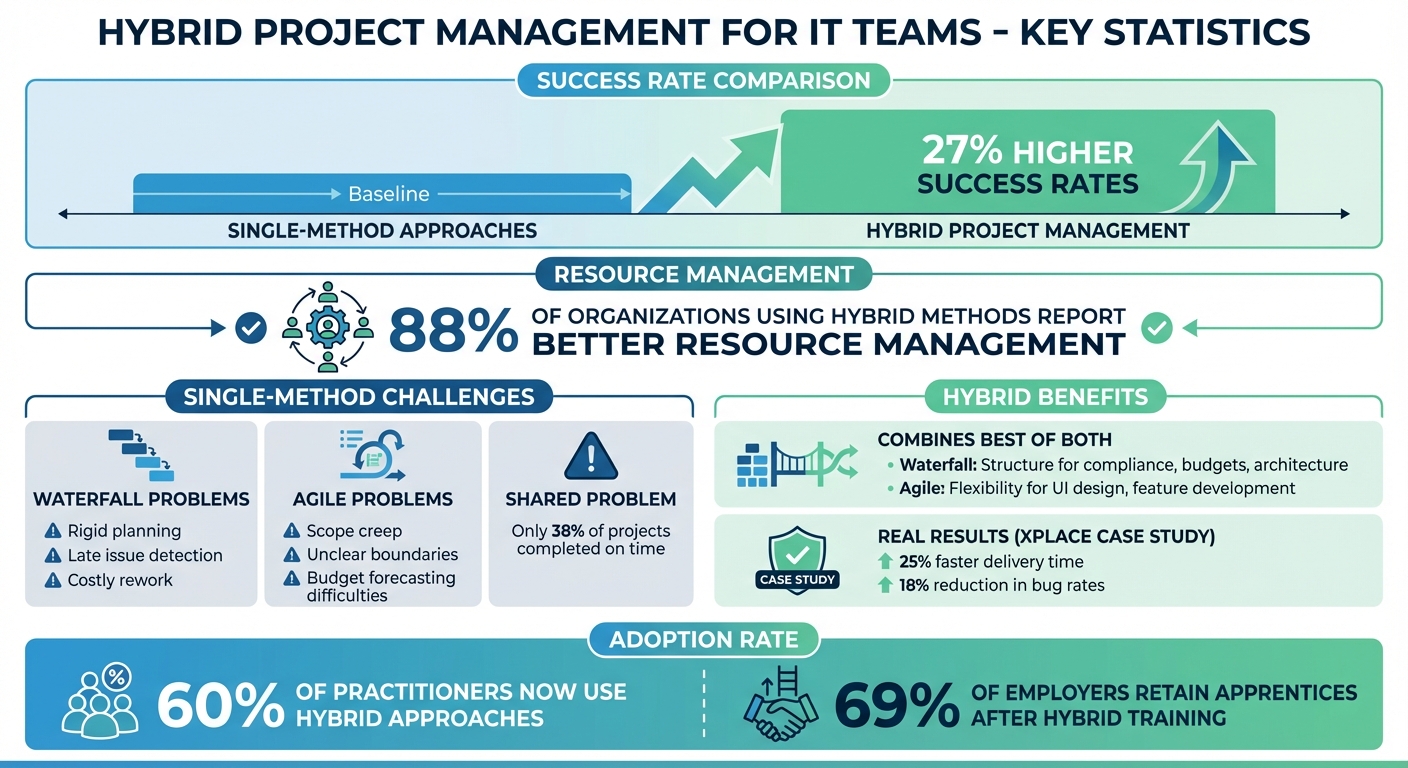
Hybrid vs Single-Method Project Management: Success Rates and Benefits for IT Teams
Hybrid Project Management: Combining Agile with Other Methodologies
sbb-itb-3297dc6
Common Problems IT Teams Face with Single-Method Project Management
Relying solely on Waterfall or Agile methodologies can introduce challenges that derail IT projects. These limitations highlight the need for a more balanced, hybrid approach.
Waterfall’s Rigid Planning Doesn’t Adapt to IT’s Evolving Needs
Waterfall assumes that all project requirements can be determined upfront. However, IT projects often face changing technical constraints, evolving user demands, and shifting priorities. Once the project moves into execution, accommodating changes becomes costly and complex.
The step-by-step process of Waterfall – planning, design, development, and testing – means that critical issues often emerge late, during final testing. At this stage, addressing problems can require expensive rework or even restarting the project. John Allan, Head of Services at Agenor, points out: during a NowSkills expert webinar
"Waterfall’s rigid structure might struggle to adapt to rapidly evolving regulatory changes and shifting educational priorities, which are common in the education sector."
This rigidity can hinder IT teams across industries where adaptability is crucial, making it hard to keep pace with fast-changing requirements.
Agile’s Lack of Boundaries Encourages Scope Creep
Agile’s flexibility, while beneficial, often results in unclear project boundaries. Without well-defined limits, teams may find it difficult to determine when the work is truly complete. Shawn Dickerson from Workfront’s Enterprise Solutions Group explains:
"It’s basically done when the client is happy, which means the end result could look completely different than what you envisioned at the beginning."
This open-ended approach complicates budgeting and forecasting, as the final deliverables and total costs can deviate significantly from initial estimates. Conventional metrics like time and cost tracking often become unreliable, leaving stakeholders unsure about progress or delivery timelines.
Misalignment and Resource Management Challenges
When teams rely on a single-method approach, collaboration across departments can become strained. For example, engineering teams that depend on structured, long-term roadmaps may clash with marketing teams working in short, iterative cycles. Sean O’Connor, Content Specialist at monday.com, notes:
"Engineering may rely on structured documentation and long-term roadmaps. Marketing often works in short creative cycles. Operations teams depend on predictable timelines… The friction starts when these teams need to deliver something together."
This misalignment creates inefficiencies, as teams must reconcile conflicting reporting styles – such as Waterfall’s fixed timelines versus Agile’s sprint metrics. The result? Delivery delays and wasted effort. In fact, only 38% of projects are completed on time, partly due to the time lost resolving these differences instead of focusing on delivering results.
These challenges underline why many IT teams are turning to hybrid project management methods, which offer a balance between structured planning and the flexibility needed to adapt to change.
What Hybrid Project Management Means for IT Teams
Hybrid project management offers a way to tackle the challenges of rigid structures and undefined workflows by blending the best of two worlds: Waterfall’s structured planning and Agile’s adaptability. This method allows IT teams to apply the right approach at the right stage of a project. As highlighted in PMI’s Pulse of the Profession 2024 report:
"Hybrid management frameworks are gaining ground as the fit-for-purpose approach as organisations combine predictive and agile practices on projects."
This approach creates a balance where projects can have clear milestones while still being flexible enough to adapt during execution.
For IT teams, Waterfall elements provide the foundation by defining phases such as scope, timelines, budgets, and compliance requirements. On the other hand, Agile elements bring flexibility to daily operations, using tools like sprints, backlogs, and frequent reviews to adjust to feedback and evolving needs. For example, Waterfall might be used to establish architecture and security protocols, while Agile methods like Scrum or Kanban drive the software development process.
One popular framework is the "Sandwich" model, where the project starts with Waterfall for requirements gathering and design, transitions to Agile for the development phase, and then shifts back to Waterfall for final testing and deployment. This structure bridges the gap between predictability and flexibility, giving stakeholders firm timelines and budgets while allowing technical teams the freedom to iterate as needed.
The benefits of this approach are clear. Data shows that 88% of organisations using hybrid methods report better resource management, and hybrid teams often achieve stronger department alignment. For instance, XPlace, a cloud-based software startup, used Waterfall to set clear timelines and scope before moving to one-month Agile sprints for feature development. The results? A 25% faster delivery time and an 18% reduction in bug rates. CEO Allon Mason remarked: "We released the product on time…and improved quality by reducing bugs by 18%."
How Hybrid Project Management Helps IT Teams
Hybrid project management offers practical benefits for IT teams juggling tight deadlines, shifting requirements, and demanding expectations. By blending structure with adaptability, this approach enhances flexibility, communication, and risk management.
Greater Flexibility Without Losing Structure
Hybrid frameworks adapt to the specific demands of each project. For IT teams, this often means using Waterfall for fixed elements and Agile for iterative tasks. This division allows leaders to focus on overarching goals like budgets and timelines, while delivery teams handle daily operations through tools like backlogs and sprints. The result? Strategic control without unnecessary micromanagement. In fact, research shows hybrid projects have 27% higher success rates than those sticking to a single methodology. The ability to pivot when necessary, without discarding the entire plan, is a game-changer.
This adaptability also lays the groundwork for improved communication with stakeholders.
Better Communication with Stakeholders
A standout advantage of hybrid management is its ability to act as a "translation layer" between different organisational priorities. Executives want predictability – clear budgets, timelines, and deliverables. Meanwhile, development teams need room to tackle challenges as they arise. Hybrid methods strike a balance by combining defined requirements with Agile practices like sprint reviews and demos. This approach keeps executives informed while giving developers the freedom to innovate.
Instead of a "black box" where progress is unclear, hybrid models offer transparent backlogs that invite regular feedback. This shared visibility bridges communication gaps, creating a unified understanding of the project’s status.
Earlier Risk Detection and More Efficient Resource Use
Hybrid models excel at spotting risks early. Waterfall planning identifies large-scale risks upfront, while Agile iterations uncover emerging issues during development. This layered approach ensures problems are addressed while they’re still manageable, avoiding last-minute crises.
The resource management benefits are just as striking. Waterfall provides an initial framework for resource allocation, while Agile allows for dynamic adjustments – like shifting developers to tackle a critical bug during testing. This adaptability ensures resources are used effectively. It’s no wonder 88% of organisations using hybrid methods report better resource management, enabling teams to leverage their strengths throughout the project lifecycle.
Popular Hybrid Methodologies for IT Projects
IT teams looking to balance structure with flexibility often turn to hybrid frameworks. These approaches combine the best aspects of established methodologies, allowing teams to tailor their workflows to specific project needs. Here are three widely used hybrid methods for IT projects, each offering a unique way to manage complexity.
Agile-Waterfall Hybrid
In this model, the Waterfall approach is used to outline scope, requirements, and architecture, while Agile sprints handle development and testing. A popular variation, sometimes called the "Sandwich" model, begins with Waterfall for planning, transitions to Agile for iterative development, and ends with Waterfall processes for stabilisation and release. This method works particularly well for IT projects that merge hardware’s linear planning needs with software’s iterative design process.
To ensure cohesion, link key Waterfall milestones – such as "security review complete" – to Agile sprint goals. This prevents the processes from becoming disjointed and aligns team outputs with leadership expectations. As John Allan, Head of Services at Agenor, explains:
"Hybrid project management marries the strengths of both Waterfall and Agile, offering adaptability while maintaining a level of structure that can be beneficial for various project phases."
Scrumban (Scrum-Kanban Hybrid)
Scrumban blends the structured elements of Scrum – like backlogs, retrospectives, and daily stand-ups – with Kanban’s visual workflows and pull-based task system. One of its key features is on-demand planning, which replaces rigid sprint planning sessions. Planning happens only when tasks in the "Ready" column drop below a set threshold, making it particularly useful for IT support and maintenance teams that need to balance planned improvements with unexpected support requests. Work-in-progress (WIP) limits also help prevent teams from being overwhelmed, ensuring high-priority tasks are completed before new ones are added.
This flexibility makes Scrumban an excellent choice for teams handling unpredictable workloads while maintaining focus on critical tasks.
Phased Delivery and Dual-Track Agile
Phased delivery is ideal for projects with strict deadlines or fixed budgets, such as those in regulated industries like finance or education. Here, Waterfall is used for stable, predictable elements – like architecture, security requirements, and vendor contracts – while Agile manages evolving components like user experience flows and feature prioritisation. This approach provides stakeholders with clarity and predictability while still allowing for iterative adjustments during execution.
Dual-Track Agile takes a different approach by splitting work into two parallel tracks: discovery and delivery. The discovery track focuses on identifying user needs and validating ideas through research and prototyping. Meanwhile, the delivery track concentrates on coding and shipping features. This method is particularly effective when requirements are in flux, ensuring teams build features that truly meet user needs.
Each of these hybrid methodologies offers IT teams a way to adapt their processes to the unique demands of their projects, blending structure with flexibility to achieve better outcomes.
How to Implement Hybrid Project Management in Your IT Team
Shifting to hybrid project management takes careful planning. IT teams need to evaluate their specific needs, select the right combination of methodologies, and ensure everyone is aligned with the new system.
Evaluate Your Team’s Needs and Project Requirements
Start by analysing how your team operates and the demands of your projects. Map out your current workflows, noting how each department functions. For example, engineering teams might already follow structured processes, while marketing or design teams may prefer more flexible, iterative methods. Identifying these differences helps pinpoint where a hybrid model could address inefficiencies.
To assess projects effectively, consider five key factors:
- Team size: Agile works best with smaller teams, while predictive models like Waterfall are better suited for larger groups.
- Criticality: High-stakes projects in regulated industries often require structured approaches.
- Dynamism: How often do requirements change? Agile thrives in dynamic environments.
- Personnel skills: Creative problem-solvers tend to excel in Agile, while rule-based thinkers align with Waterfall.
- Organisational culture: Does your company prioritise stability or encourage flexibility?
By examining these factors, you can decide which parts of a project need rigid planning – such as compliance documentation or vendor contracts – and which areas, like user interface design or feature prioritisation, are better suited to iterative methods.
Choose the Right Tools and Methods
Opt for tools that support both Gantt charts and Kanban boards in a unified platform. Solutions like Productive, monday.com, or Jira with Gantt extensions allow seamless data sharing between different views. This integration is crucial because Waterfall teams plan with hours and deadlines, while Agile teams rely on story points and velocity. A tool that bridges these approaches ensures smooth collaboration.
Define clear transition points in your project. For instance, you might use Waterfall for requirements gathering and architecture design, then switch to Agile sprints once the scope is locked in. With the right tools in place, focus on establishing workflows and providing targeted training.
Create Workflows and Train Your Team
Develop workflows that integrate both approaches, with clear transition points and reporting guidelines to avoid silos. Link key milestones in Waterfall to Agile sprint goals to ensure processes remain cohesive.
Training is a critical step that often gets overlooked. Instead of teaching Agile or Waterfall separately, run workshops that focus on combining the two. Help your team understand why some tasks need structure while others benefit from flexibility. Identify leaders within the team to champion the new approach.
Begin with a pilot project to test the hybrid model without disrupting critical operations. Measure performance using metrics like Waterfall schedule variance and Agile sprint velocity. Use these insights to refine your strategy before rolling it out across the entire IT department.
How NowSkills IT Apprenticeships Teach Hybrid Project Management
Combining Structured Learning with Agile Sprints
NowSkills IT apprenticeships embrace the principles of hybrid project management by blending structured learning with adaptable, hands-on methods. These programmes combine formal, government-endorsed curricula with flexible, iterative learning techniques. For instance, IT Infrastructure and Data Analytics apprenticeships follow a dual-track model. This approach starts with accredited coursework to establish core knowledge, then transitions into practical labs and on-demand tools, all delivered in Agile-inspired cycles.
Take Data Analytics apprenticeships as an example. Apprentices utilise tools like the Data Analytics Project Planner to set specific goals and deadlines, which then generate tailored timelines and task lists. They work with technologies such as PowerBI, Python, and AI in iterative cycles, distinguishing tasks that require a rigid framework from those that thrive in a more flexible setup.
Training delivery is equally adaptable. Sessions are accessible online via Zoom or Teams, as well as in-person, giving apprentices a taste of the dynamic environments they’ll encounter in modern IT teams. This method ensures a balance between clear structures and the ability to adjust when needed.
Equipping IT Professionals for Today’s Workplaces
This hybrid learning model is about more than just technical skills. It also sharpens the professional abilities that are crucial in today’s IT landscape. NowSkills apprenticeships focus on developing behaviours that align with hybrid project management practices. Apprentices gain experience in managing stakeholder expectations, navigating complex communication networks, and maintaining frequent, effective engagement – skills that are increasingly essential. As Jane Marshall-Nichols, Chief Operating Officer at CITI Limited, explains:
"You are likely to be engaging more frequently, and sharing a wider set of messages, with your stakeholders than before [in a hybrid project]."
The curriculum is developed in collaboration with top UK employers to ensure it addresses current workplace demands. This includes preparing apprentices to work with emerging technologies like AI, cloud computing, and data analytics. By combining employer insights with government funding, the programme ensures graduates are equipped with both the technical know-how and the practical judgement to decide when and where to apply structured or flexible methods effectively.
Conclusion
Hybrid project management combines the detailed planning of Waterfall with Agile’s flexible, iterative approach, allowing IT teams to adjust quickly while managing stakeholder expectations effectively. This method bridges the gaps between rigid traditional frameworks and the short-term focus of pure Agile, offering a balanced solution.
By integrating Agile sprints for faster feature delivery with Waterfall-inspired governance to maintain scope and quality, hybrid methods create a structured yet adaptable workflow. Early planning, paired with ongoing reviews, strengthens risk management by identifying potential issues early and addressing them iteratively. With 60% of practitioners now using hybrid approaches, it’s clear that modern IT projects require both strategic planning and operational flexibility.
Different hybrid methodologies, such as Water-Scrum-Fall, Scrumban, and SAFe Hybrid, provide adaptable frameworks tailored to specific project needs. These approaches highlight how IT teams can effectively merge structured oversight with the agility needed for innovation.
However, successful implementation goes beyond just adopting a framework. It involves careful preparation: defining roles, fostering clear communication, and equipping teams with the necessary training in both technical practices and a mindset geared towards flexibility. Starting with smaller pilot projects helps teams fine-tune their methods before scaling up.
To build these skills, IT apprenticeships play a key role. Programmes like those offered by NowSkills incorporate hybrid principles into training, preparing future IT professionals to balance structured governance with the demands of rapid innovation. With 69% of employers retaining apprentices after their training, investing in hybrid project management skills benefits both organisations and individuals in the long term.
FAQs
When should we use Waterfall vs Agile in one IT project?
When deciding between approaches, it’s all about what the project demands. Waterfall is ideal for projects with well-defined and stable requirements, where changes are unlikely – think regulatory or infrastructure work. Its step-by-step, sequential process ensures predictability and order. On the other hand, Agile shines in scenarios where flexibility and regular feedback are key, such as software development. Its iterative nature allows teams to adapt quickly to changes. For more complex IT projects, a hybrid approach can be a middle ground, blending Waterfall’s structured planning with Agile’s iterative flexibility to handle both stability and evolving needs.
How can we prevent scope creep in a hybrid approach?
To keep scope creep at bay in hybrid project management, it’s crucial to start with clear goals and a well-defined scope. Without this foundation, projects can easily spiral out of control.
A robust change management process is another key element. This ensures that any adjustments to the plan are carefully evaluated and approved before being implemented. Alongside this, maintaining open communication with stakeholders is essential. Everyone involved should understand the project’s boundaries and the potential impact of any changes.
It’s also important to regularly review progress and stick to the original scope as much as possible. When changes are proposed, having set procedures in place to evaluate and approve them will help keep everything on track and prevent unnecessary deviations.
What metrics work best for tracking hybrid projects?
When managing hybrid projects, combining traditional and Agile metrics offers a well-rounded approach to tracking progress and performance.
Traditional metrics often focus on areas like project completion rates, resource utilisation, budget adherence, milestones, and return on investment (ROI). These measures help ensure that the project stays on track financially and operationally.
On the other hand, Agile metrics bring a different perspective by concentrating on sprint performance, quality indicators, and how well the team adapts to changes. These metrics are particularly useful for monitoring flexibility and responsiveness throughout the project.
Additional measures, such as stakeholder satisfaction, time management, and the planned-to-done ratio, further enhance the evaluation process. Together, these metrics provide a comprehensive view of progress, enabling teams to make informed adjustments while maintaining control and increasing the likelihood of success.


