
IT downtime costs Global 2000 companies £320 billion annually, or £160 million per company on average. Traditional maintenance approaches – reactive fixes or fixed schedules – fail to address this challenge effectively. Predictive maintenance, powered by machine learning, offers a smarter solution by anticipating system failures before they occur.
Key Points:
- Predictive maintenance uses real-time data, AI, and machine learning to monitor IT systems and detect potential failures.
- It reduces downtime by 35–45% and cuts maintenance costs by 25–30%.
- Machine learning models analyse metrics like temperature, power usage, and system logs to predict issues.
- Techniques include anomaly detection (unsupervised learning) and failure prediction (supervised learning).
By shifting to predictive maintenance, IT teams can prevent up to 75% of unexpected breakdowns, improve reliability, and optimise maintenance schedules. This approach ensures systems stay operational while reducing unnecessary repairs and costs.
Use Machine Learning to Implement Effective Predictive Maintenance
sbb-itb-3297dc6
How Machine Learning Enables Predictive Maintenance
Machine learning transforms raw IT data into actionable insights that help prevent equipment failures. It all starts with data acquisition – IoT sensors and monitoring tools gather telemetry data from servers, storage devices, and network equipment. These sensors track metrics like temperature, power usage, system logs, and performance data. This information is then streamed to edge buffers or centralised data lakes, where it undergoes preprocessing, feature engineering, model training, and inference.
Feature engineering plays a crucial role by refining raw data into specific "condition indicators" – metrics such as temperature spikes or unusual CPU activity that can signal early warning signs. These indicators are fed into machine learning models, which analyse hundreds of variables at once, uncovering patterns and correlations that would be impossible for humans to detect manually.
Data Collection and Real-Time Monitoring
Real-time monitoring shifts IT maintenance from reactive to proactive. Instead of relying on scheduled checks or responding to failures, machine learning continuously analyses live data streams to evaluate system health. The architecture typically combines edge and cloud processing: while intensive model training occurs centrally in the cloud using data from across the system, lightweight inference happens at the edge – on industrial controllers or gateways. This approach reduces latency and ensures operations continue smoothly, even during network disruptions.
Context is a game-changer for accuracy. Machine learning models don’t just process raw metrics; they also consider factors like workload, operating cycles, and ambient temperature. By integrating this contextual information, algorithms can distinguish between normal wear and tear and genuine signs of degradation, leading to fewer false alarms. The system improves over time, as every maintenance action and its outcome are fed back into the model. This continuous refinement pushes prediction accuracy beyond 90%, making anomaly detection highly reliable.
Detecting Anomalies and Predicting Failures
Anomaly detection acts as an early warning system. Using unsupervised learning methods like autoencoders, machine learning defines a baseline for "normal" system behaviour. It then flags deviations, such as sudden memory usage spikes, unusual network traffic, or subtle changes in disk performance. As Cloudera aptly describes it:
"Modern assets do not fail out of the blue. They whisper first. Predictive maintenance is about listening to those whispers with data, then acting before the shout becomes a shutdown."
When historical failure data is available, supervised learning takes the lead to predict specific failure types. These models handle tasks like binary classification (e.g., will this component fail?) or regression analysis to calculate the Remaining Useful Life (RUL) – the time left before a component completely fails. By combining anomaly detection with precise failure predictions, IT teams can plan maintenance during scheduled downtime, avoiding the chaos of unexpected outages.
Benefits of Machine Learning for Predictive Maintenance
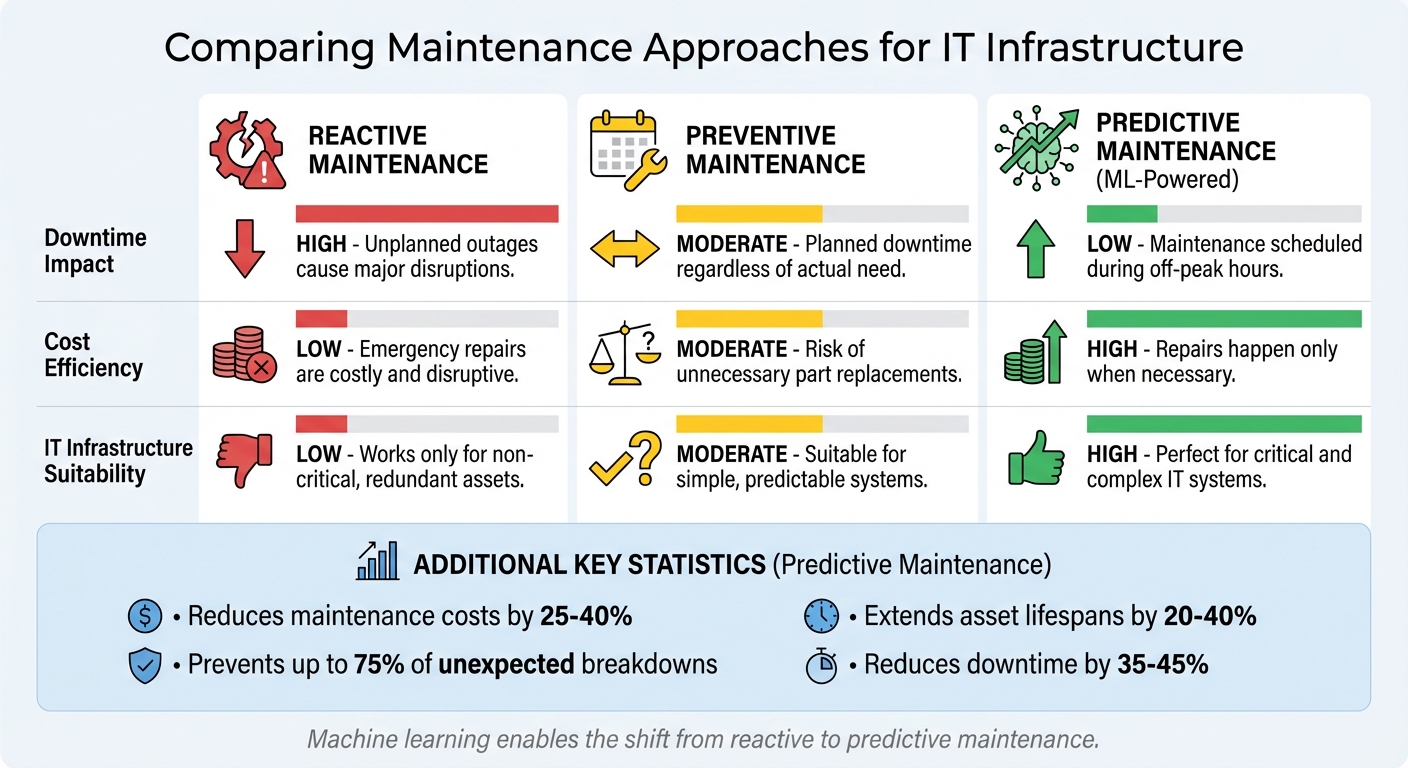
Comparing Reactive, Preventive, and Predictive Maintenance Approaches for IT Infrastructure
Machine learning is changing the game for IT maintenance, shifting it from reactive problem-solving to proactive planning. Organisations using machine learning for predictive maintenance report cutting overall maintenance costs by 25–40% while preventing up to 75% of unexpected breakdowns. The result? Fewer disruptions and smoother daily operations.
One standout advantage is better resource allocation. Instead of relying on fixed schedules, machine learning triggers maintenance only when there’s evidence of wear or degradation. This avoids the waste of preventive strategies, where perfectly functional parts are often replaced prematurely. A great example comes from FleetDynamics Corporation. By using AI to monitor brake pad wear across 1,500 commercial vehicles, the company saved £4.2 million annually and boosted fleet availability.
Comparing Maintenance Approaches
Machine learning-based predictive maintenance stands apart from traditional methods, as shown below:
| Approach | Downtime Impact | Cost Efficiency | IT Infrastructure Suitability |
|---|---|---|---|
| Reactive Maintenance | High: Unplanned outages cause major disruptions | Low: Emergency repairs are costly and disruptive | Low: Works only for non-critical, redundant assets |
| Preventive Maintenance | Moderate: Planned downtime regardless of actual need | Moderate: Risk of unnecessary part replacements | Moderate: Suitable for simple, predictable systems |
| Predictive Maintenance | Low: Maintenance scheduled during off-peak hours | High: Repairs happen only when necessary | High: Perfect for critical and complex IT systems |
Improved System Reliability and Lower Costs
Predictive maintenance doesn’t just save money – it also makes systems more reliable. According to McKinsey, this approach can extend asset lifespans by 20–40%. Machine learning identifies early warning signs, such as overheating, irregular power usage, or subtle performance dips, preventing small issues from escalating into major failures. Deloitte adds that predictive maintenance can reduce facility downtime by 5–15% and increase labour productivity by 5–20%.
For IT teams, this means fewer emergency fixes, more time for strategic projects, and a better work-life balance. You can learn more about these trends in our digital webinars featuring industry experts. Considering that unplanned downtime costs the largest 500 global companies about 11% of their annual revenue, the case for predictive maintenance is clear. It’s a smarter way to ensure uninterrupted IT operations while keeping costs under control.
Machine Learning Techniques for Predictive Maintenance
Choosing the right machine learning technique hinges on the type of data you have and the specific predictions you need. IT teams often decide between supervised learning, which relies on historical failure data, and unsupervised learning, which focuses on analysing raw sensor data. Here’s a closer look at the key approaches driving predictive maintenance.
Supervised Learning Models
Supervised learning involves training algorithms on labelled datasets, where historical sensor data is paired with known failure events. For instance, spikes in temperature, unusual vibrations, or pressure changes might be tagged to indicate whether they led to a breakdown. These patterns help the algorithm predict future failures.
Supervised models generally fall into two categories:
- Classification models: These answer binary questions like "Will this machine fail in the next 48 hours?" or classify failure types, such as distinguishing between a disk failure and a cooling system issue.
- Regression models: These estimate the Remaining Useful Life (RUL) of a component, predicting how many hours or days it can operate before requiring maintenance.
Popular algorithms include Decision Trees, Random Forests, Support Vector Machines (SVM), and Logistic Regression. For example, a global home appliance manufacturer implemented an Extreme Gradient Boosting classifier, achieving over 90% accuracy in forecasting system failures. This innovation reduced maintenance costs by 5%.
Unsupervised Learning for Anomaly Detection
Unsupervised learning is perfect for situations where labelled failure data is unavailable. It identifies anomalies in raw sensor data by detecting deviations from normal operating patterns, making it highly suited to preventive maintenance.
Common techniques include:
- Clustering algorithms: Methods like K-means group similar operational behaviours.
- Autoencoders and Principal Component Analysis (PCA): These uncover hidden patterns in complex datasets.
For instance, EV Connect, an electric vehicle charging provider, used unsupervised methods like DBSCAN, Isolation Forest, and Local Outlier Factor to detect unusual charging sessions without needing labelled failure data. Similarly, in the UK, Kortical applied predictive maintenance models to 22,000 mobile network towers, successfully identifying 52% of failures before they occurred.
As Serhii Leleko, an ML & AI Engineer at SPD Technology, explains:
An algorithm can analyze vibration data from a rotating machine and predict an impending bearing failure based on abnormal vibration patterns. Maintenance will be scheduled to replace the bearing before it fails, preventing unplanned downtime.
How to Implement Predictive Maintenance in IT Infrastructure
Steps to Move from Reactive to Predictive Maintenance
Shifting to predictive maintenance requires careful planning and a step-by-step approach. Instead of trying to overhaul your entire system at once, focus on critical assets – those whose failures cause the most disruption. These might include bottleneck systems, safety-critical infrastructure, or revenue-impacting services. By prioritising these areas, you can maximise the impact of your initial efforts.
The next step involves data acquisition and preparation. Start collecting historical logs and real-time sensor data, focusing on parameters like temperature, power consumption, and system performance. If you lack sufficient failure data, consider using physics-based models to simulate it. Aim to gather data over a period of 14 to 90 days to capture typical operational patterns. Split this dataset into training and testing subsets to validate your predictive models effectively.
Feature engineering is crucial here. Identify "condition indicators" – specific data features that signal healthy versus faulty operation. These indicators feed into your machine learning models. For model selection, use supervised learning if you have labelled failure data, or opt for unsupervised learning to detect anomalies when historical failures aren’t well-documented.
Begin with a pilot project focusing on one critical asset. This allows you to refine your approach while establishing data governance standards, including quality thresholds. As Jen Canfor, Global Campaign Manager for SUSE AI, explains:
The value of an AI prediction depends on it being actionable. Ideally, your AI findings will seamlessly integrate into existing maintenance workflows.
By following these steps, IT teams can move from reactive maintenance to a predictive approach, setting the stage for machine learning-driven automation. The next challenge is integrating these predictive insights into your existing IT systems.
Connecting Machine Learning with IT Systems
Integration requires a four-step architecture: collecting sensor data, transmitting it in real time to central systems, applying AI/ML analytics, and triggering automated actions. Use edge devices for processing data on-site and cloud or on-premise servers for running complex models.
To streamline operations, integrate machine learning insights with existing CMMS or ERP systems via APIs. This allows for automated work order generation, technician scheduling, and inventory management based on predictive insights. Deliver predictive algorithms in formats like shared libraries, web apps, Docker containers, or packages to ensure compatibility with minimal recoding.
To build trust and encourage adoption, choose models that offer "reason codes" – explanations for why an alert was triggered. This transparency helps IT technicians understand and act on predictions. Evaluate model performance using the F1 score, which balances precision and recall to provide a more comprehensive accuracy metric.
Keep refining your models by incorporating technician feedback and new data. Retrain models whenever you adjust KPIs or add new assets, as performance can degrade over time due to "model drift". This ongoing process ensures your predictive maintenance system stays accurate and adapts to changes as your infrastructure evolves.
Conclusion
Machine learning is transforming IT maintenance by shifting the focus from reactive fixes to condition-based interventions. By analysing real-time and historical data, machine learning models can reduce maintenance costs by up to 40% and prevent as much as 75% of unexpected breakdowns. This allows for just-in-time repairs, which not only extend the lifespan of assets but also improve resource management across IT operations. This shift is helping organisations address the growing gap in human skills within the IT sector.
Predictive maintenance also plays a role in tackling the skills gap, with only 21% of UK workers currently feeling confident using AI at work. Accredited training programmes, like those provided by NowSkills, are equipping the workforce with the tools needed to manage these technologies. Government-funded apprenticeships are proving crucial, offering training in IT Infrastructure and Data Analytics. These programmes teach practical skills in technologies like Python, PowerBI, and AI tools for anomaly detection, all funded through the apprenticeship levy. With the UK government aiming to equip 10 million workers with AI skills by 2030, employers can use these initiatives to upskill their teams or bring in new talent without additional recruitment costs.
As technologies like Digital Twins, Edge AI, and Predictive Maintenance-as-a-Service continue to evolve, AI literacy is becoming an essential skill for IT infrastructure roles. The pace of innovation is only set to grow, making it vital for organisations to stay ahead in this rapidly changing landscape.
FAQs
How does predictive maintenance help minimise IT downtime?
Predictive maintenance uses machine learning to keep IT systems running smoothly by tracking their performance and condition in real time. By examining data patterns, it can spot potential problems early, giving you the chance to fix them before they lead to any major disruptions.
This forward-thinking method allows you to plan maintenance during convenient periods, cutting down on unexpected breakdowns and keeping your IT operations running efficiently.
What are the key machine learning techniques used in predictive maintenance?
Predictive maintenance uses machine learning techniques to predict potential IT infrastructure failures before they happen. It often involves analysing sensor data – like temperature or pressure readings – and time series data, which monitors changes over time. These approaches help uncover patterns and detect anomalies that might signal a problem.
In addition, AI-driven models play a crucial role in forecasting equipment issues and fine-tuning maintenance schedules. With these tools, organisations can minimise downtime, boost efficiency, and prolong the lifespan of their IT systems.
How can organisations use predictive maintenance to improve their IT systems?
Predictive maintenance in IT systems uses machine learning to analyse data and spot potential problems before they arise. It starts with gathering data from IT infrastructure – things like performance metrics, error logs, and temperature readings. This data must be cleaned and prepared to ensure accurate analysis.
Once that’s set, machine learning models trained on historical data can identify patterns and anomalies. These models work in real time, predicting failures and suggesting actions to prevent them. The result? Less downtime, longer equipment lifespan, and better use of resources.
For successful implementation, organisations need to invest in the right tools, infrastructure, and skills. Encouraging a data-driven approach can significantly boost the reliability and efficiency of IT systems, helping organisations tackle issues before they escalate.


