
Building a mentorship programme for apprentices can significantly improve their skill development, confidence, and integration into the workplace. By pairing apprentices with experienced staff, you create a supportive environment where they can navigate challenges and grow professionally. Here’s how to get started:
- Define clear goals: Identify what the programme aims to achieve, such as improving technical skills, boosting retention, or preparing to recruit a new apprentice for specific roles.
- Select and train mentors: Choose mentors with technical expertise and good interpersonal skills. Provide training on communication, feedback, and safeguarding.
- Pair thoughtfully: Match mentors and apprentices based on skills, goals, and communication styles to ensure productive relationships.
- Structure the programme: Set a timeline (e.g., six months), schedule regular check-ins, and outline milestones for skill development.
- Monitor and refine: Use metrics like retention rates, skill progression, and participant feedback to measure success and make improvements.
Mentorship helps apprentices connect their training to real-world tasks while enhancing productivity and retention for organisations. Start small, refine your approach, and scale up for long-term success.
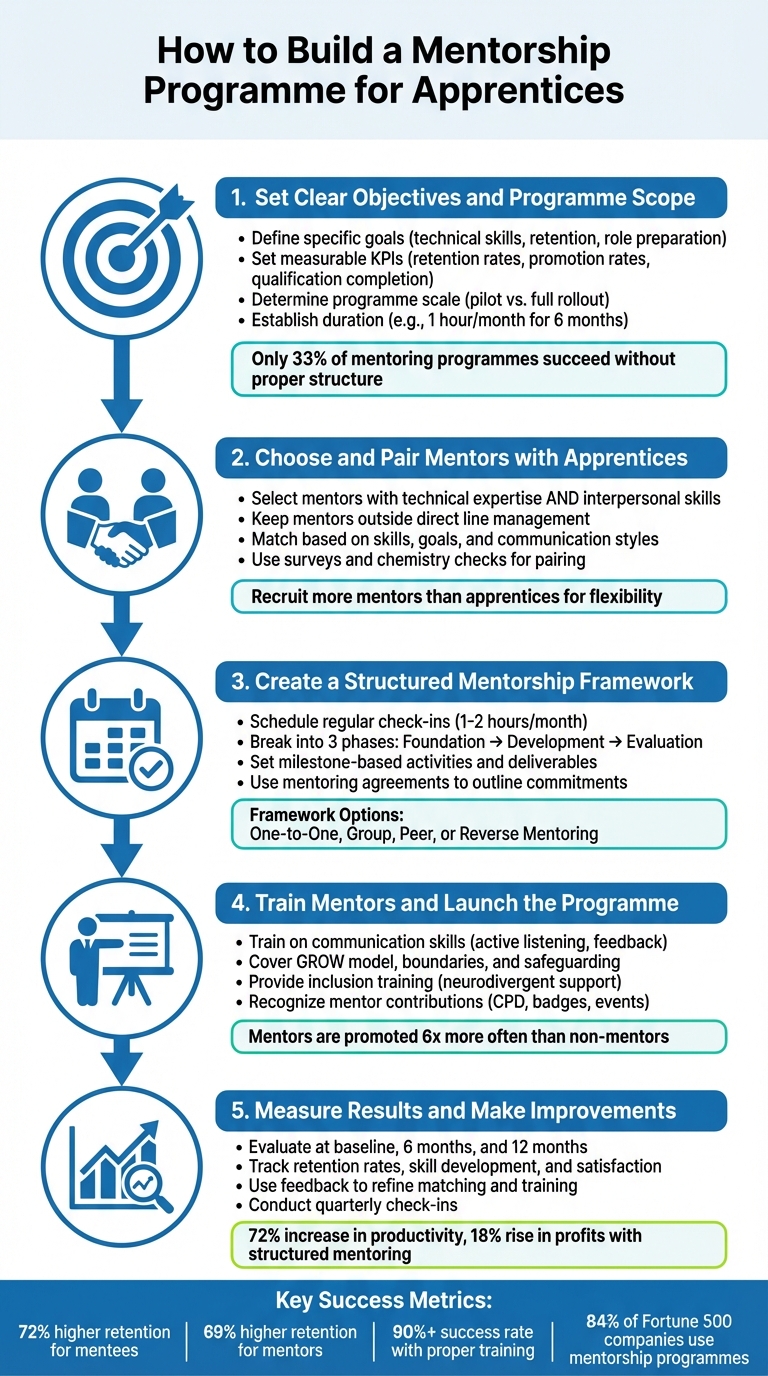
5-Step Process to Build an Effective Apprentice Mentorship Programme
Line Manager Responsibilities | Essential Guide to Mentoring Apprentices
sbb-itb-3297dc6
Step 1: Set Clear Objectives and Programme Scope
Before pairing mentors with apprentices, it’s crucial to define the objectives of your mentorship programme. Without a clear purpose, mentoring relationships can lack focus and fail to deliver measurable results. Research indicates that only about one-third of mentoring programmes succeed without proper training and structure.
Start by identifying the specific challenges your programme aims to address. Are you looking to enhance technical expertise in areas like IT infrastructure, cyber threat analysis, or data analytics? Perhaps your focus is on improving staff retention or cutting recruitment costs. Alternatively, you might want to help apprentices achieve professional registration. Anita Davenport-Brooks, People, Culture and Compliance Manager at Lander Automotive Ltd, highlights their forward-thinking approach:
"We see apprenticeships as key for the future. We want to make sure we continue to grow our employees internally."
Your objectives should also separate supply-side goals, such as addressing technical skills shortages, from demand-driven goals like diversifying your workforce. This distinction ensures the programme aligns with your organisation’s digital strategy. For instance, if your business is expanding its data analytics capabilities, your mentorship programme should focus on developing those skills while also fostering the professional attitudes needed in the tech industry.
Set Measurable Goals
Concrete, measurable targets are essential for tracking progress throughout the programme. Structured mentoring can lead to a 72% increase in productivity and an 18% rise in profits. To aim for similar outcomes, establish Key Performance Indicators (KPIs) early on – such as apprentice retention rates, promotion rates within 12 months, or the percentage of apprentices completing their planned qualifications.
Consider goals that address both technical skills and professional growth. For example, apprentices might complete vendor certifications, contribute to live projects within six months, or show measurable improvements in confidence and independence. Having clear, measurable objectives also strengthens your business case when seeking leadership buy-in. By comparing programme outcomes with company averages, you can demonstrate a tangible return on investment.
Define the Programme Scope
Determine the scale and boundaries of your mentorship programme. Will you start with a pilot project or roll it out across multiple departments? A smaller launch allows you to test and refine your framework before scaling up.
Set clear parameters for the duration of mentoring partnerships – such as one hour per month over six months – and specify the digital skills that align with your business needs. This helps prevent scope creep and ensures both mentors and apprentices have a clear understanding of their commitments from the beginning.
Once you’ve established your objectives and scope, the next step is selecting and pairing mentors with apprentices.
Step 2: Choose and Pair Mentors with Apprentices
The success of any mentorship programme hinges on selecting the right mentors and creating effective pairings. According to ScreenSkills, mentors should be open to sharing their experiences while understanding they don’t need to have all the answers. Prioritise individuals who bring both technical know-how and strong interpersonal skills to the table.
Select the Right Mentors
When choosing mentors, look for a combination of technical expertise and the ability to connect with others. For digital IT apprentices, this might mean staff with specialised knowledge in areas like IT support, data analytics, software development, or digital marketing. But technical skills alone won’t cut it – mentors also need to excel in communication, empathy, and commitment to the mentoring relationship.
Most importantly, mentors should not be part of the apprentice’s direct line management. As ScreenSkills points out:
"Mentoring partnerships should take place outside of the usual line management structure."
This separation allows apprentices to speak openly about challenges, ask questions freely, and explore their vulnerabilities without fear of judgement from their immediate boss.
The ideal mentor listens actively, provides constructive feedback, and acts as a supportive sounding board. They should also be willing to commit time – typically around an hour per month for six months – and show genuine interest in the apprentice’s growth. Recruiting more mentors than apprentices ensures flexibility and helps maintain the quality of matches.
Once you’ve identified a pool of qualified mentors, the next step is to align their strengths with the specific needs of each apprentice.
Match Mentors and Apprentices Thoughtfully
Creating effective pairings isn’t just about matching technical skills. Use tools like surveys and informal chemistry checks to align mentors and apprentices based on expertise, career goals, and communication preferences. As Employment Hero explains:
"The best matches are based not just on skills and experience, but also on personality and communication styles."
You might also consider reverse mentoring, where mentors can learn fresh perspectives on emerging technologies from their apprentices.
For digital IT apprentices, ensure the mentor’s expertise – whether in cybersecurity, data analytics, or IT infrastructure – aligns with the apprentice’s learning objectives and career aspirations. Companies like Softcat have shown how structured mentoring programmes can help apprentices adapt effectively, especially in hybrid or remote work settings. With the right pairings in place, the next step is to establish a clear framework to guide these partnerships.
Step 3: Create a Structured Mentorship Framework
To ensure your mentorship programme is productive and consistent, it’s essential to align the framework with the objectives and scope you’ve already established.
Schedule Regular Check-Ins
Consistency is more impactful than frequency. A schedule of 1–2 hours per month over six months works well. This approach gives apprentices enough time to work on their development goals between sessions while keeping the momentum going.
Encourage apprentices to take ownership by scheduling meetings and setting their agendas. At the start of the programme, hold a three-way contracting session involving the programme manager, mentor, and apprentice. This structured meeting ensures everyone is aligned on the programme’s goals from day one. A formal mid-point review can also provide an opportunity to address challenges and make adjustments if needed.
For remote or hybrid teams, use secure digital platforms to share asynchronous updates.
Once regular meetings are in place, set clear milestones to measure tangible progress.
Include Milestone-Based Activities
Break the programme into three distinct phases: Foundation (building rapport and setting goals), Development (tracking progress through regular reviews), and Evaluation (concluding with feedback and reflection).
Within these phases, tie milestone-based reviews to practical goals. For instance, a data analytics apprentice might complete a dashboard project by month three, while a digital marketing apprentice could launch a social media campaign by the programme’s midpoint. These deliverables not only structure discussions but also highlight practical skill development.
Use mentoring agreements or learning contracts signed at the outset to outline objectives, meeting schedules, and confidentiality rules. Reinforce the apprentice’s commitment by linking mentoring hours to Continuing Professional Development (CPD) points in their personal development plan.
Encourage apprentices to document key takeaways and action items after each session.
With milestones in place, you can now explore different mentorship models to tailor the programme further.
Compare Different Mentorship Models
Mentorship programmes come in various forms, and the model you choose should reflect your apprentices’ needs, available resources, and organisational goals. Here’s a comparison of some common approaches:
| Mentorship Model | Pros | Cons | Best-Fit Scenario |
|---|---|---|---|
| One-to-One | Offers personalised guidance; builds trust and confidentiality | Resource-intensive; depends on mentor-apprentice chemistry | Ideal for apprentices requiring focused technical or career development |
| Group Mentoring | Encourages networking; reduces isolation; lessens pressure on senior staff | Limited individual attention; may be challenging for neurodivergent participants | Best for fostering peer learning and efficient knowledge sharing |
| Peer Mentoring | Strengthens cross-departmental relationships; provides role-specific advice | May lack the depth of experience senior mentors bring | Suitable for employees at similar levels sharing insights |
| Reverse Mentoring | Promotes cross-generational learning; helps senior staff stay updated on trends | Can feel awkward if power dynamics aren’t managed well | Great for bridging generational gaps or sharing expertise in technology and social media |
For apprentices in technical fields like IT & Digital Apprenticeships, one-to-one mentoring is often the most effective, offering the focused attention needed to navigate complex challenges. Meanwhile, group mentoring is a practical choice when mentor availability is limited but there’s a desire to encourage peer collaboration – for example, an experienced IT specialist guiding a small team of apprentices.
Reverse mentoring can also add a unique dimension. Imagine a junior apprentice with expertise in emerging technologies mentoring senior staff. This approach fosters mutual learning and boosts the apprentice’s confidence.
Statistics show that mentoring has a strong impact: retention rates are 72% higher for mentees and 69% higher for mentors compared to those not involved in mentoring programmes.
A well-thought-out framework like this sets the stage for effective mentor training and a successful programme launch.
Step 4: Train Mentors and Launch the Programme
Now it’s time to prepare your mentors and officially launch your programme.
Run Mentor Training Sessions
Training your mentors is a crucial step. Focus on sharpening their communication skills, including active listening, building rapport, and giving constructive feedback. These skills form the backbone of any successful mentoring relationship.
Introduce them to the GROW model (Goal, Reality, Options, Will) to help them structure their conversations effectively. Make sure they’re familiar with the apprenticeship framework, including the programme structure and End-Point Assessments. This knowledge equips mentors to provide guidance that’s both practical and aligned with the programme’s goals.
It’s also vital to cover professional boundaries, ethics, and safeguarding. Mentors need to understand how their role differs from that of a line manager. Ideally, mentoring should remain separate from direct line management.
Inclusion and accessibility are equally important. Train mentors to support neurodivergent apprentices and those who may not have English as their first language. Equip them to identify signs of mental health challenges, such as anxiety or low mood, and direct apprentices to professional support services when necessary. For example, apprentices in the UK can access a free Work Mental Health Support Service funded by the Department for Work and Pensions.
To fine-tune your approach, consider starting with a pilot programme. Train a small group of mentors first, gather feedback, and make adjustments before rolling it out across the organisation. Encourage mentors to participate in peer support sessions where they can share experiences and solve challenges together. This helps create a sense of community and eases any feelings of isolation they might encounter.
"Mentoring represents ‘nurturing all of our talent’. Put more bluntly, ‘you can’t afford not to’." – ScreenSkills
Once mentors are trained, the focus shifts to keeping them engaged and motivated.
Motivate Mentor Participation
It’s essential to show mentors what’s in it for them. Highlight how mentoring benefits not just the apprentices but also the mentors themselves. For instance, mentoring is a great leadership development tool, helping mentors enhance their coaching, communication, and management skills. Research shows that mentors are promoted six times more often than those who don’t participate in mentorship programmes.
Another perk? Two-way learning. Through reverse mentoring, mentors gain fresh insights from younger or junior employees, particularly on topics like technology, social media, or industry trends. This exchange of knowledge keeps senior staff engaged and up to date.
Recognising mentors’ efforts is key to maintaining their enthusiasm. Offer formal recognition through digital badges, shoutouts in newsletters, or even hosting “graduation” events to celebrate their contributions. Link mentoring to Continuing Professional Development (CPD) opportunities, making it a valuable addition to their career progression. This could even count towards professional registration requirements.
To keep mentors connected, set up peer support networks on platforms like Slack or WhatsApp. These spaces allow mentors to share best practices and address challenges collectively. Regular communication is also important – check in with mentors at least quarterly to share updates, testimonials, and relevant resources.
Kick off the programme with an official launch event, such as a workshop or induction session. This is the perfect opportunity to set expectations, define roles, and bring everyone together. Provide a mentorship handbook that outlines the programme structure, code of conduct, ethical guidelines, and key milestones. In the first month, have mentors and apprentices sign a simple agreement to formalise their commitment, confidentiality, and meeting schedules.
"The mentoring I received was without a doubt one of the most valuable contributors in building the confidence I have now and developing me into the person I am today." – Emma Beauchamp, Former Apprentice, Gestamp
The numbers speak for themselves. Organisations with mentoring programmes report profits that are 18% higher than average, while those without them experience 45% lower profits. Beyond the financial benefits, mentoring also improves retention and professional development, directly supporting the goals you’ve set for the programme. With mentors now trained and motivated, the stage is set for a successful launch and future evaluations.
Step 5: Measure Results and Make Improvements
After launching your programme, tracking its performance is crucial. Start by evaluating progress at three key points: at the outset to establish a baseline, after six months to check the health of relationships, and at the 12-month mark to assess overall outcomes. This timeline helps pinpoint what’s working and what needs adjustment.
Monitor Key Performance Indicators
Once the programme is live, focus on specific metrics to measure its success. Begin with apprentice retention rates – compare these with your company’s overall retention figures to determine whether mentorship is improving apprentice retention. Evaluate skill development through tools like assessments, performance reviews, and progress tracking against individual learning plans.
Keep an eye on productivity and the broader business impact. Organisations with mentoring programmes often see productivity rise by 72%, profits increase by 18%, and staff retention rates improve by 20% compared to those without such initiatives. Use participant satisfaction as another key metric – gather insights through pulse surveys, questionnaires, and interviews to measure engagement levels and the quality of mentor-apprentice relationships. This also highlights how mentors are building leadership and coaching skills.
To gather feedback effectively, use a mix of questionnaires for quick insights and interviews for more in-depth understanding. Even in informal programmes, encourage mentors to summarise meetings and document action points. Establishing a baseline at the start ensures you can track real progress over time.
Refine the Programme Based on Data
With data in hand, use your findings to fine-tune the programme. If feedback uncovers mismatched expectations or poor mentor-apprentice dynamics, consider recontracting – a structured discussion to address concerns and reset goals. Revisit your matching process and adjust criteria to prioritise tailored apprenticeship options that focus on skills, personality traits, or communication styles that lead to better pairings.
Host regular mentor workshops where participants can share their experiences and discuss common challenges. These sessions can inform updates to training materials and provide additional support. If particular mentors face recurring issues, offer targeted Continuing Professional Development (CPD) sessions to address their needs.
Maintain open communication through quarterly check-ins to address potential problems like drop-outs or communication breakdowns before they escalate. Assign a dedicated coordinator, such as an HR professional, to handle questions and resolve issues flagged through feedback. Let apprentices contribute to the agenda for group events and feedback sessions, ensuring the programme stays relevant to their needs. Keep in mind that while only 33% of mentoring relationships succeed without training, over 90% thrive when both mentors and mentees receive adequate support.
Conclusion
By combining clear objectives, thoughtful pairing methods, and structured training, your mentorship programme is set to thrive. Start by defining specific goals, whether it’s bridging technical skills gaps, improving employee retention, or nurturing future leaders. Carefully match mentors and apprentices based on skills, aspirations, and personalities, incorporating "chemistry check" meetings to ensure a genuine connection. These essential steps lay the groundwork for a programme that can deliver meaningful results.
To keep things on track, implement regular check-ins and ensure mentors are trained in active listening and providing constructive feedback.
Mentorship programmes have proven to deliver tangible benefits. Companies that embrace mentoring often report higher profits, improved promotion rates, and stronger retention. In the fast-changing digital IT sector, mentorship fosters the sharing of critical technical knowledge, encourages collaboration across disciplines, and builds a culture of continuous learning. It also plays a key role in developing the leadership pipeline needed for long-term growth. With 84% of Fortune 500 companies already leveraging mentorship programmes, the real question is no longer "should you implement one?" but "how soon can you get started?"
To maximise these benefits, ongoing evaluation is essential. Track metrics like retention rates, skill progression, and participant satisfaction to identify areas for improvement. Use this data to refine your approach and ensure the programme evolves to meet the needs of both apprentices and the organisation. A mentorship programme isn’t a static initiative – it’s a dynamic framework that strengthens over time as you learn what works best.
FAQs
What are the main benefits of having a mentorship programme for apprentices?
A well-designed mentorship programme can be a game-changer for both apprentices and employers. For apprentices, it means tailored support, faster skill-building, and a confidence boost in their professional environment. It also opens doors to meaningful networking opportunities and creates a sense of belonging and encouragement.
For employers, the benefits are just as compelling. Mentorship programmes can lead to higher apprentice engagement, better retention rates, and a noticeable lift in productivity. By committing to mentorship, businesses not only nurture a more capable and driven workforce but also set the stage for long-term success for both the organisation and its apprentices.
How can I measure the success of a mentorship programme for apprentices?
To gauge how well a mentorship programme is working, start by establishing clear objectives and defining key performance indicators (KPIs) that reflect both the growth of apprentices and your business goals. Typical KPIs might include retention rates of apprentices, the time it takes them to reach competency, progress in skill development, and employee satisfaction levels.
Keep track of progress by documenting mentoring sessions – note the dates, durations, main discussion points, and any agreed actions. Assess the programme at specific milestones, such as 6 and 12 months in, to evaluate its impact and the effectiveness of mentor-apprentice relationships. Gather feedback from both mentors and apprentices using surveys or interviews, and pair this with measurable outcomes like increased productivity or enhanced business results.
Use the data collected to make improvements where necessary – this could involve reassigning mentor-mentee pairs, enhancing mentor training, or adjusting the schedule of meetings. Regular reviews and updates will help ensure the programme remains beneficial for apprentices and your organisation alike. NowSkills offers tailored support to help you monitor and analyse these metrics, ensuring your digital IT apprenticeships deliver meaningful results.
What should you consider when pairing mentors with apprentices?
To build effective mentor-apprentice relationships within a digital IT apprenticeship programme, it’s important to focus on several key aspects:
- Relevant expertise: The mentor should have solid technical knowledge and hands-on experience in the apprentice’s chosen area, whether it’s IT Infrastructure, Digital Marketing, or another field. This ensures they can offer practical, real-world insights.
- Personal compatibility: Pair mentors and apprentices based on their personalities, communication styles, and career goals. A good match fosters trust and a stronger working relationship.
- Understanding of learning needs: Mentors should be able to adapt their guidance to align with the apprentice’s development targets and translate the apprenticeship framework into meaningful, actionable tasks.
- Commitment to mentoring: Select mentors who can dedicate time for regular one-on-one sessions. Consistent feedback and support are crucial for the apprentice’s growth.
- Safeguarding awareness: For younger apprentices, it’s essential that mentors understand safeguarding policies to ensure a safe and supportive environment.
By taking these factors into account, you can create partnerships that not only build confidence but also sharpen skills and set apprentices on the path to long-term success in their careers.


