
The UK faces a growing tech skills gap, leaving many roles in IT, AI, and digital marketing unfilled. Digital apprenticeships are emerging as a practical solution, combining work experience with targeted training to address this shortage. Key takeaways:
- The Problem: Over 90,000 apprenticeship vacancies were advertised between Aug 2024 and Apr 2025, yet dropout rates remain high at 47%. Many employers struggle to find candidates with the right skills, such as AI, Python, and PowerBI.
- Economic Impact: Apprenticeships contribute £550 million annually to the UK economy, with a £21 return for every £1 invested.
- Challenges: Mismatched skills, lack of awareness, and uneven opportunities across regions hinder progress.
- The Solution: Programmes like those offered by NowSkills focus on in-demand areas like data analytics and digital marketing, providing hands-on training and government-funded support.
Digital apprenticeships are bridging the gap between industry needs and workforce readiness, helping both individuals and businesses thrive in the evolving tech landscape.
Bridging the digital skills gap with Ben Higgin – PwC UK – Future of Work

Problems That Keep the Tech Skills Gap Open
Despite the growing demand for digital talent, several ongoing challenges continue to widen the skills gap in the UK. These hurdles affect both individuals aspiring to break into tech and employers struggling to find qualified candidates. Let’s take a closer look at the key issues contributing to this persistent problem.
Skills Don’t Match Job Requirements
One of the biggest obstacles is the mismatch between the skills job seekers have and what employers actually need. Many candidates lack hands-on experience with the tools and technologies that are essential in today’s workplace. For instance, employers often report that applicants are unfamiliar with platforms like Google Analytics, advanced data tools, or cybersecurity protocols.
This disparity is also evident in apprenticeship programmes. While STEM apprenticeships have a slightly better completion rate (57.3%) compared to non-STEM subjects (52%), nearly half of participants still fail to meet industry standards. The rapid pace of technological change only makes this worse – skills that were relevant two years ago may already be outdated in fast-moving fields like artificial intelligence or cloud computing.
Employers frequently cite gaps in digital literacy, coding skills, and practical experience as significant barriers to hiring. For example, a candidate might understand marketing theory but lack the technical know-how to use social media advertising platforms or data analysis tools that businesses rely on daily.
Barriers That Block Apprenticeship Access
Another major issue is the lack of awareness about digital apprenticeships. Many young people and career changers don’t know these opportunities exist or are unaware of the benefits they offer, which keeps the skills gap wide open.
Even for those who are interested, the application process can be confusing and discouraging. Candidates often struggle to find clear information or guidance on how to apply. For someone considering a shift into IT or digital marketing, navigating these complexities can feel like an uphill battle.
Employer participation is another sticking point. Only 51% of UK employers are involved in apprenticeship programmes, with the figure rising to 66% among larger companies. Without more widespread involvement, there simply aren’t enough positions to meet demand, and existing training programmes often fail to align with real-world industry needs.
Geographic disparities add another layer of difficulty. Opportunities are not evenly distributed across the UK, making it harder for candidates in certain areas to access apprenticeships. As Isaac Paxton noted in October 2025, finding opportunities “very close to my home” was critical to his success.
Age-related challenges also play a role. While apprenticeship starts for older age groups have risen, those for under-19s fell by 4.1% to 67,130 in 2024/25. This suggests that younger candidates may face unique hurdles when trying to access these programmes.
Changing Skill Needs in Digital Jobs
The rapid evolution of technology is another factor that complicates the tech skills gap. Skills that were cutting-edge last year may already be standard today, and new competencies are constantly emerging. Fields like artificial intelligence, machine learning, and advanced data analytics are reshaping job requirements faster than training programmes can keep up.
This constant change means workers must continually update their skills to stay relevant. For example, a digital marketing apprentice might master one platform, only to find that new algorithms or regulations have completely altered how it functions. Similarly, IT professionals need to stay on top of advancements in cloud computing, cybersecurity, and software development.
The problem isn’t just about learning new tools – it’s about developing the ability to keep learning throughout a career. Traditional education models with fixed curricula often fail to prepare students for this reality, leaving them unprepared for the demands of the workplace.
High dropout rates from training programmes reveal the disconnect between what’s being taught and what employers need. When education doesn’t align with industry demands, apprentices quickly realise they’re not gaining the skills required for the job. This creates a vicious cycle: programmes fail to produce skilled workers, employers lose faith in apprenticeships, and the skills gap persists.
The issue is particularly pronounced in emerging fields like AI and data science. These areas require expertise so new that there simply aren’t enough experienced trainers available. This bottleneck makes it nearly impossible to meet the growing demand for these skills effectively.
How Digital Apprenticeships Fix the Skills Gap
With the UK’s tech industry facing a growing shortage of skilled professionals, digital apprenticeships offer a direct and practical solution. Unlike traditional education, which often struggles to keep up with the fast-changing demands of the tech world, these programmes create a seamless link between learning and real-world application. They ensure that apprentices gain the precise skills employers are actively seeking.
How Digital Apprenticeships Work and What They Offer
Digital apprenticeships blend on-the-job training with focused classroom instruction, allowing apprentices to apply what they learn immediately. Typically, participants split their time between working for an employer and receiving structured training.
From the outset, apprentices work on real projects, using industry-standard tools and methods. This hands-on approach not only provides valuable experience but also aligns perfectly with what employers need, helping to quickly build a skilled workforce.
Financially, digital apprenticeships are appealing. Apprentices earn an average salary of £19,706 during their training, avoiding the burden of student debt that often comes with university education. For employers, the benefits are equally clear: apprentices contribute to an average annual revenue boost of £33,759, and every £1 invested in apprenticeships generates £21 for the UK economy.
Government support plays a key role in making these programmes accessible. Up to 95% of training costs are covered by government funding, and initiatives like the Apprenticeship Levy encourage larger organisations to invest in developing their workforce. In the 2024/25 academic year, 67.4% of apprenticeship starts were funded through the levy.
Interestingly, 60% of apprentices remain with their employer after completing their training, creating a steady pipeline of skilled workers and supporting long-term career growth.
Programmes Designed for Digital Skills Development
Digital apprenticeships are tailored to meet the needs of high-demand roles in the tech industry. Programmes focus on areas like Digital Marketing, IT Infrastructure, Content Creation, and Data Analytics – fields where the UK faces a noticeable shortage of skilled professionals.
These programmes are developed in collaboration with employers to ensure they address current industry needs. For example, NowSkills offers specialised training such as the Content Creator with Artificial Intelligence Tools (Level 3) programme, which incorporates AI into content creation, and the Data Analyst with PowerBI & Python (Level 4) programme, equipping apprentices with cutting-edge tools. Other offerings include the Multi-Channel Marketer with Artificial Intelligence Tools (Level 3) and the Data Technician with Business Insights and Analytics (Level 3) programmes, both designed to meet the evolving demands of the tech landscape.
Employer involvement ensures that apprentices gain skills that are immediately applicable in the workplace, bridging the gap between theoretical learning and practical application. The growing popularity of higher-level apprenticeships (Levels 4–7) underscores their value. In 2024/25, starts for these advanced programmes rose by 11%, with Level 6 and 7 starts increasing by 13%. These now account for 17.5% of all apprenticeship starts, reflecting their appeal as a strong alternative to traditional degrees.
Comparing Digital Apprenticeships and University Degrees
| Aspect | Digital Apprenticeships | University Degrees |
|---|---|---|
| Access | Open to anyone aged 16+ with no UCAS requirements | Typically requires A-levels and UCAS points |
| Cost | Funded by government/employers; includes a salary | Tuition fees (£9,250+/year) often lead to student debt |
| Hands-on Experience | Immediate practical application in the workplace | Limited work experience, depending on placements |
| Qualification | Industry-recognised certifications | Academic degree with a broader focus |
| Duration | 1–4 years, depending on the level | Usually 3–4 years |
| Employer Engagement | Direct involvement in programme design | Minimal industry input |
| Job Readiness | Focus on practical, job-specific skills | Emphasis on theoretical knowledge |
The financial benefits of apprenticeships are striking. While university students often accumulate debt and delay earning an income, apprentices earn a salary from day one and complete their training debt-free. This makes apprenticeships particularly appealing to career changers and those for whom university might not be financially viable.
Moreover, the hands-on experience gained through apprenticeships addresses a key employer concern: the lack of practical skills among graduates. By working on real business challenges with up-to-date tools and techniques, apprentices develop both technical expertise and workplace professionalism, making them highly valuable to employers.
However, not all programmes are created equal. With a dropout rate of 47%, it’s crucial to choose providers with strong support systems and proven success rates. Providers like NowSkills, which boasts a 4.7/5 rating on Trustindex, demonstrate how effective guidance and close collaboration with employers can lead to positive outcomes.
"I got the apprenticeship I desired. Good communication, very detailed information about the course contents, guidance given every step of the way. Quality." – Syed, Apprentice
This feedback highlights the importance of comprehensive support in ensuring apprentices thrive during their training.
sbb-itb-3297dc6
NowSkills: Digital Apprenticeship Success Story
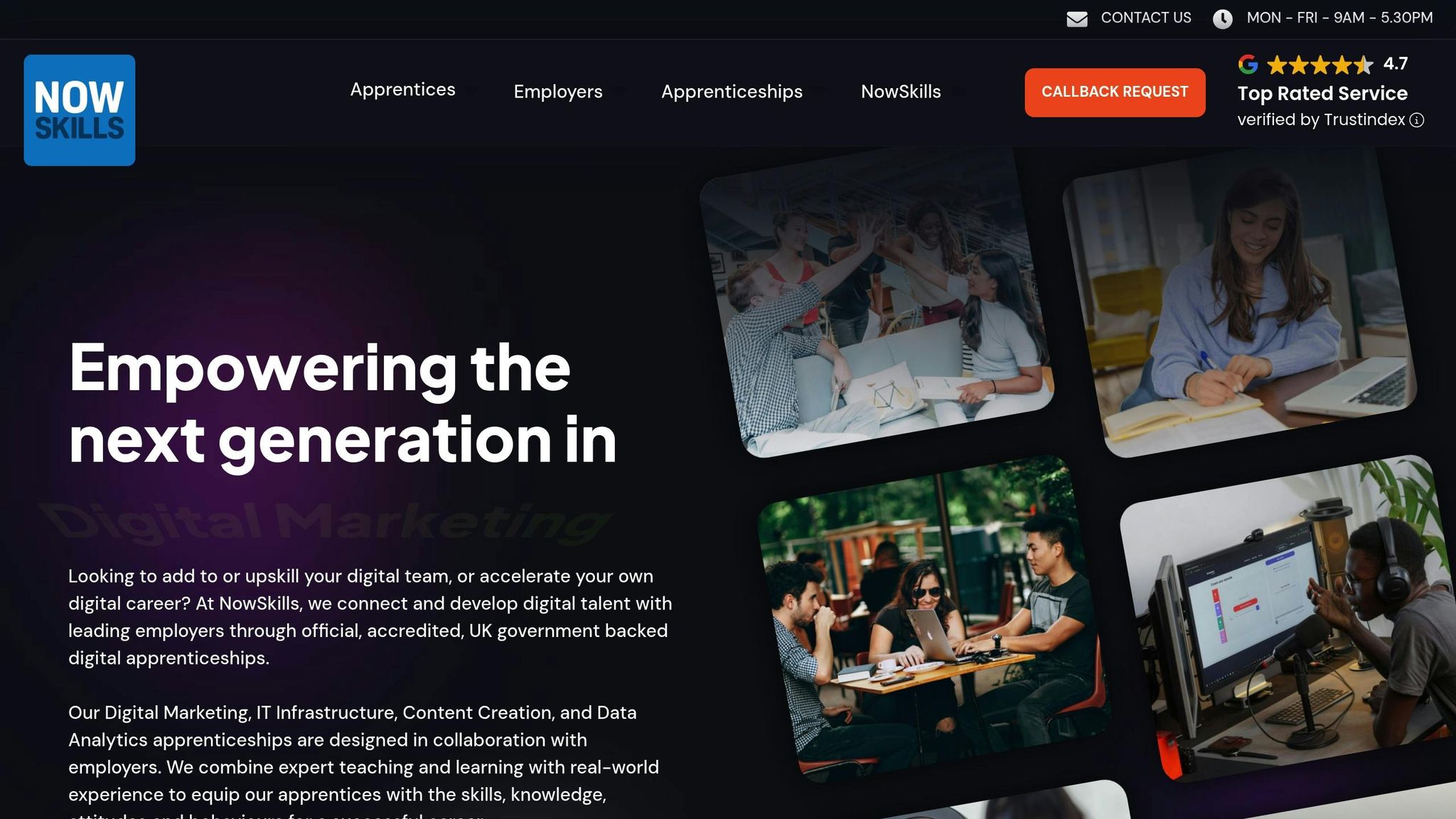
As businesses across the UK grapple with a growing tech skills shortage, NowSkills has stepped up as a key player in addressing this challenge. Specialising in accredited digital and IT apprenticeships, their government-funded programmes are designed to bridge the gap between industry demand and skilled talent, equipping apprentices for immediate roles in the tech sector.
NowSkills Programme Options
To tackle the tech skills gap head-on, NowSkills offers a wide range of apprenticeship programmes tailored to meet industry needs. These programmes cover essential areas such as Digital Marketing, IT Infrastructure, Content Creation, and Data Analytics. Each programme is crafted to align with current industry standards and regional requirements. For example, a Content Creation apprenticeship integrates technologies like artificial intelligence to streamline processes, while the Level 4 Data Analytics apprenticeship trains participants in advanced tools such as PowerBI and Python. The increasing popularity of higher-level apprenticeships – projected to grow by 13% in 2024/25 at Levels 6 and 7 – highlights NowSkills’ commitment to developing the advanced expertise today’s employers demand.
Employer Partnerships and Government Funding
NowSkills collaborates with leading UK companies to design apprenticeship programmes that directly address industry requirements. These programmes are largely funded by the government, with up to 95% of training costs covered. This allows employers to onboard new apprentices or upskill their existing workforce with minimal financial burden. On top of that, NowSkills connects businesses with eager IT apprentices – often with no recruitment fees – helping to improve workforce retention, enhance productivity, and deliver measurable results. The impact is substantial: apprentices contribute an average of £33,759 annually in revenue and collectively add £550 million to the British economy each year. To ensure success, NowSkills offers comprehensive support services that bolster the apprenticeship experience for both employers and apprentices.
Support Services for Apprentices and Employers
NowSkills goes beyond training by offering robust support services aimed at reducing dropout rates, which currently stand at 47%, and ensuring higher completion rates. Apprentices benefit from dedicated career consultants who guide them through every step of the application and interview process. They also gain access to hundreds of live apprenticeship vacancies updated daily.
"Extremely helpful and friendly and secured me an apprenticeship within 3 weeks of me first applying." – Harvey Carmichael
"The process was clear, supportive and straightforward. Everything was clearly explained and communication was amazing. My advisor Katie Ballegher… boosted my confidence, prepared me for my interview and helped me land my dream apprenticeship." – Mariam Noor
For employers, NowSkills ensures high-quality delivery through a dedicated Board of Governors and a Quality Assurance team, achieving a Trustindex rating of 4.7/5. Employers also benefit from webinars featuring industry experts who share insights on IT trends and career strategies. This inclusive, values-driven approach not only supports apprentices’ professional development but also embeds British Values and promotes wellbeing, helping apprentices make meaningful contributions to the tech industry.
Future Plans: Creating a Digitally Skilled Workforce
The UK’s approach to digital apprenticeships is set to undergo significant changes, focusing on increasing participation, updating training programmes, and driving economic growth. As the digital sector evolves, these efforts will play a crucial role in building a skilled workforce prepared for tomorrow’s challenges.
Encouraging More Participation in Apprenticeships
Recent data highlights both hurdles and opportunities in the apprenticeship landscape. A noteworthy trend is the rise of older apprentices, with individuals aged 25 and over making up 48.4% of starts (137,570). This shift shows that digital apprenticeships are becoming a valuable option for those looking to pivot their careers into tech-focused roles.
To attract younger participants, awareness campaigns need to spotlight the clear benefits of digital apprenticeships: earning while learning, gaining hands-on experience, and avoiding the financial strain of student loans. The growing popularity of higher-level apprenticeships – up by 11.0% to 111,520 in 2024/25 – indicates that advanced digital qualifications are increasingly viewed as a credible alternative to university degrees.
Simplifying the ASA levy process, which can cover up to 95% of training costs, is another crucial step. This change is expected to encourage more small and medium-sized enterprises (SMEs) to participate, unlocking significant economic returns (every £1 invested generates £21). Together, these measures aim to ensure apprenticeships remain aligned with the needs of a rapidly changing workforce.
Adapting to the Future of Work
The content of digital apprenticeships is evolving to keep pace with technological advancements like AI, cloud computing, and machine learning. Programmes offered by training providers such as NowSkills reflect this shift, with courses like Content Creator with AI Tools (Level 3) and Data Analyst with PowerBI & Python (Level 4) showcasing how apprenticeships are adapting to emerging trends.
The demand for degree-level qualifications is also on the rise, as evidenced by the 13.0% increase in Level 6 and 7 apprenticeships, which reached 49,780 starts. This aligns with the growing need for advanced skills in the tech industry, ensuring apprentices are equipped to meet employers’ expectations.
Collaborations between training providers and tech companies are further enhancing the relevance of apprenticeship programmes. By integrating current industry practices and tools into their curricula, these partnerships provide apprentices with practical, hands-on experience, easing their transition from training to full-time employment.
Long-Term Impact of Digital Apprenticeships
The expansion of digital apprenticeships is set to not only address immediate skill shortages but also reshape the UK’s economic future. Since May 2010, more than 5 million people have embarked on apprenticeship programmes, laying a strong foundation for workforce transformation.
Digital apprenticeships contribute to economic growth in several ways: they create direct pathways into high-demand tech roles, boost productivity through a skilled workforce, and reduce reliance on costly external recruitment. Additionally, they help tackle unemployment by offering accessible entry points into lucrative careers.
On a regional level, digital apprenticeships are tailored to meet local skill demands, fostering clusters of tech expertise across the country. This approach can strengthen regional economies, create more resilient labour markets, and increase tax revenues as digital professionals secure higher-paying roles. Over time, these efforts will enhance the UK’s competitiveness in the global digital economy.
The growing confidence in apprenticeships is evident in the 2.2% rise in learner participation, which reached 703,110 individuals. As digital apprenticeships continue to evolve, they are poised to become the go-to option for tech skills development, ensuring a steady supply of professionals ready to meet the challenges of the future economy.
FAQs
How do digital apprenticeships compare to university degrees in terms of cost and career preparation?
Digital apprenticeships, such as those offered by NowSkills, provide a practical way to gain skills by blending on-the-job experience with expert-led training. This approach equips individuals with the knowledge and tools needed to step directly into roles within the tech and digital industries.
Unlike the more traditional route of a university degree, apprenticeships offer the advantage of earning while you learn. There are no tuition fees to worry about, and you start earning a salary from day one. This makes it an appealing option for anyone aiming to build a career in fields like IT, digital marketing, or data analytics – without the burden of hefty student loans.
What challenges do digital apprenticeships face in closing the UK’s tech skills gap, and how are they being addressed?
Digital apprenticeships are becoming a key solution to the UK’s tech skills shortage, bridging the gap between what the education system offers and what industries actually need. But keeping up with fast-changing technologies and ensuring these programmes align with employer expectations can be tricky.
To tackle these issues, government-funded training programmes are providing a practical blend of expert-led learning and real-world experience. Organisations like NowSkills work directly with businesses to design apprenticeships in areas such as IT, Digital Marketing, and Data Analytics. This ensures that apprentices gain the skills employers are actively looking for. The result? Learners develop expertise that’s immediately useful, while businesses benefit from a workforce ready to help them grow and adapt in a highly competitive landscape.
How do digital apprenticeships stay relevant in the fast-changing tech industry?
Digital apprenticeships stay up-to-date by working closely with recognised accreditation bodies like BCS, City & Guilds, CompTIA, and Cisco. These collaborations ensure the training aligns with industry benchmarks, equipping learners with sought-after skills that employers value.
What sets these apprenticeships apart is their emphasis on practical, hands-on learning. Participants get the chance to apply their knowledge in real-world scenarios, helping them build the expertise needed to succeed in the fast-changing digital and IT industries.


