
Digital apprenticeships in the UK ensure learners gain job-ready skills while meeting industry needs. They follow strict frameworks led by employers and overseen by organisations like the Institute for Apprenticeships and Technical Education (IfATE) and Ofsted. Here’s what you need to know:
- Employer-Led Standards: Define the knowledge, skills, and behaviours (KSBs) needed for roles like Data Technician, Digital Marketer, and Cyber Security Analyst.
- End-Point Assessments (EPA): Independent evaluations ensure apprentices meet required standards through methods like professional discussions, projects, and exams.
- Regulation and Oversight: Ofqual and other bodies monitor quality, while providers must meet performance thresholds to remain eligible for funding.
- Recent Updates: Minimum apprenticeship duration reduced to 8 months (from August 2025); English and maths exit requirements made optional for apprentices aged 19+.
- Vendor Certifications: Apprentices gain additional skills through certifications from providers like Microsoft and AWS, enhancing their expertise in tools and technologies.
These programmes address digital skills shortages while maintaining high-quality training through clear standards, regular assessments, and continuous feedback mechanisms.
Core Competence Requirements Defined by Employers
Employer-Led Standards in Digital Fields
Employers play a central role in shaping digital apprenticeship standards by forming Trailblazer groups. These groups determine the knowledge, skills, and behaviours (KSBs) needed for specific roles and outline the daily tasks required for employees to be considered competent. This employer-driven model ensures that apprenticeships address actual industry needs while remaining flexible enough to serve multiple sectors.
For instance, in May 2023, organisations like BT, Virgin Media, the University of Birmingham, and the University of Exeter collaborated to define the Level 5 Digital Learning Designer standard (ST0974). This standard includes key responsibilities such as project planning and creating digital media assets. Similarly, the Data Technician standard (ST0795), established in July 2020 by companies like Fujitsu, Lloyds Banking, Accenture, and GEO Strategies, specifies that technicians must securely source, format, and present data while adhering to legal and ethical guidelines. This standard was updated in August 2025 to incorporate a focus on Generative AI and sustainable data practices.
Higher-level apprenticeships often include core and specialised duties to provide clear career pathways. For example, the Digital and Technology Solutions Professional (Level 6) standard offers six specialisation options: Software Engineer, IT Consultant, Business Analyst, Cyber Security Analyst, Data Analyst, and Network Engineer. Employers also define job titles linked to each standard, such as "E-learning developer" or "Instructional designer" for Digital Learning Designers, helping organisations align these apprenticeships with their recruitment needs. This method ensures role-specific competencies are clearly outlined and actionable.
Examples of Role-Specific Competencies
Employers further detail specific competencies for each digital role, reflecting the unique technical demands across fields. For example, IT Infrastructure apprentices must learn to configure and maintain communication networks while identifying potential security risks. In Digital Marketing, roles focus on designing and executing online campaigns across social media platforms to boost customer engagement and sales. Meanwhile, Data Analytics requires skills such as sourcing, formatting, and presenting data, alongside applying statistical techniques to uncover trends.
In May 2023, employers like Land Registry, Sainsbury’s, HMRC, and Capita developed the Digital Product Manager standard (ST0964), which covers managing the entire lifecycle of digital products. Competencies are structured by level to match workplace demands. For example, Level 3 roles like Data Technician focus on fundamental tasks such as data sourcing and formatting, while Level 4 and higher roles, such as Data Analyst, involve interpreting complex datasets to deliver strategic insights for businesses.
End-Point Assessment (EPA) and Quality Assurance
Components of the EPA
The End-Point Assessment (EPA) is the final hurdle in an apprenticeship, offering an independent review to confirm whether an apprentice has achieved the knowledge, skills, and behaviours required by their occupational standard. Before reaching this stage, apprentices must pass through the Gateway, which ensures they meet all prerequisites, such as completing their portfolio and achieving the necessary English and maths qualifications.
Digital apprenticeships feature a variety of assessment methods, each tailored to the specific role. For instance, professional discussions are structured conversations between the apprentice and an independent assessor, supported by a portfolio of evidence gathered during training. Synoptic projects involve producing a detailed 6,000-word report that outlines a technical solution. For apprentices like Digital Forensic Technicians (Level 4), assessors conduct a 7-hour workplace observation as the apprentice processes digital evidence. Some standards also include knowledge tests, such as a 60-minute online exam with 35 questions.
An independent End-Point Assessment Organisation (EPAO) oversees the process, and it must be recognised by Ofqual. Sir Ian Bauckham, Chief Regulator at Ofqual, highlights the importance of this regulation:
Effective regulation means that apprentices can be confident they are being assessed fairly. It means that apprenticeship assessments are delivered securely and are valid: they meet their stated aims, they support progression, and their standards are maintained over time.
The EPA typically spans 3 months after the training phase. For example, the Digital Forensic Technician (Level 4) apprenticeship includes 24 months of training followed by a 3-month assessment period. Similarly, the Digital and Technology Solutions Professional (Level 6) involves 48 months of training before the 3-month EPA. The cost of the EPA is capped at 20% of the apprenticeship’s funding band maximum.
The results from these assessments directly influence the grading and certification process.
Grading and Certification
Grading standards are established by employer-led Trailblazer groups and formalised in assessment plans published by the Institute for Apprenticeships and Technical Education (IfATE). These plans act as mandatory guidelines for all EPAOs, ensuring assessments are consistent across various organisations and regions. Most digital apprenticeships adopt a Fail, Pass, and Distinction grading system, although some higher-level standards, like Level 6, also include a Merit grade.
For example, in the Digital and Technology Solutions Professional (Level 6) apprenticeship, the grading matrix combines results from different assessment methods. A Pass paired with a Distinction results in a Merit grade, while two Distinctions secure an overall Distinction. Achieving a Distinction signifies the apprentice’s ability to go beyond basic competence, offering advanced technical solutions and tackling complex professional challenges.
If an apprentice doesn’t pass a component, they have the option to resit (without additional training) or retake (which requires further training). However, resits usually don’t allow for an upgrade from a Pass to a higher grade. EPAOs are also required to provide reasonable adjustments for apprentices with disabilities or long-term health conditions, such as extra time or rest breaks. Certification is awarded only after all EPA components are successfully completed, signifying the apprentice’s transition from learner to qualified professional.
External Quality Assurance (EQA) Mechanisms
Responsibilities of External Quality Assurance Bodies
External Quality Assurance (EQA) bodies act as the guardians of consistency and fairness within the apprenticeship system. Their role is to ensure that assessments meet the same high standards, no matter which provider delivers them. As Ofqual puts it:
"The purpose of EQA is to ensure that there is a consistent quality approach to assessment across an apprenticeship standard, regardless of which end-point assessment organisation is delivering the assessment and where and when this is carried out".
These organisations oversee End-Point Assessment Organisations (EPAOs) to confirm they are prepared to deliver assessments before they begin operations. Once operational, EQA bodies continue to monitor these organisations to ensure their work aligns with regulatory standards.
For higher and degree apprenticeships at Levels 6 and 7, the Office for Students (OfS) typically handles EQA, particularly for integrated degree programmes. Meanwhile, Ofqual oversees most other apprenticeship assessments. Since late 2025, Skills England has taken on a central role, managing occupational maps and apprenticeship standards while coordinating skills development across the UK.
Employer input is also a key part of the EQA process, ensuring that assessments remain aligned with industry requirements. The table below outlines the distinct responsibilities of the various organisations involved in maintaining quality.
EQA Roles vs EPAO Responsibilities
To maintain high standards across digital apprenticeships, it’s essential to understand the unique roles and responsibilities within the quality assurance system. Each organisation contributes to safeguarding the credibility of qualifications.
| Entity | Primary Role | Key Functions |
|---|---|---|
| EQA Body (Ofqual, OfS) | Oversight and regulation of assessment quality | Evaluates EPAO readiness; ensures assessment consistency; enforces compliance with IfATE frameworks |
| EPAO (End-Point Assessment Organisation) | Independent execution of final assessments | Develops assessment tools; conducts assessments; assigns grades and issues certificates |
| Skills England / IfATE | National coordination and framework development | Oversees EQA implementation; sets apprenticeship standards; manages occupational maps |
Ofqual highlights the collaborative nature of this system:
"Our aim is to ensure that regulated EPAOs can and do deliver valid assessments".
For training providers, it’s crucial to confirm that their chosen EPAO is approved by the appropriate EQA body. This ensures that final certifications meet national standards and are widely recognised by employers and professional organisations across the UK.
Digital Apprenticeship Standards – Summative Portfolio Best Practice – 26th March 2020
sbb-itb-3297dc6
Vendor Qualifications and Knowledge Modules
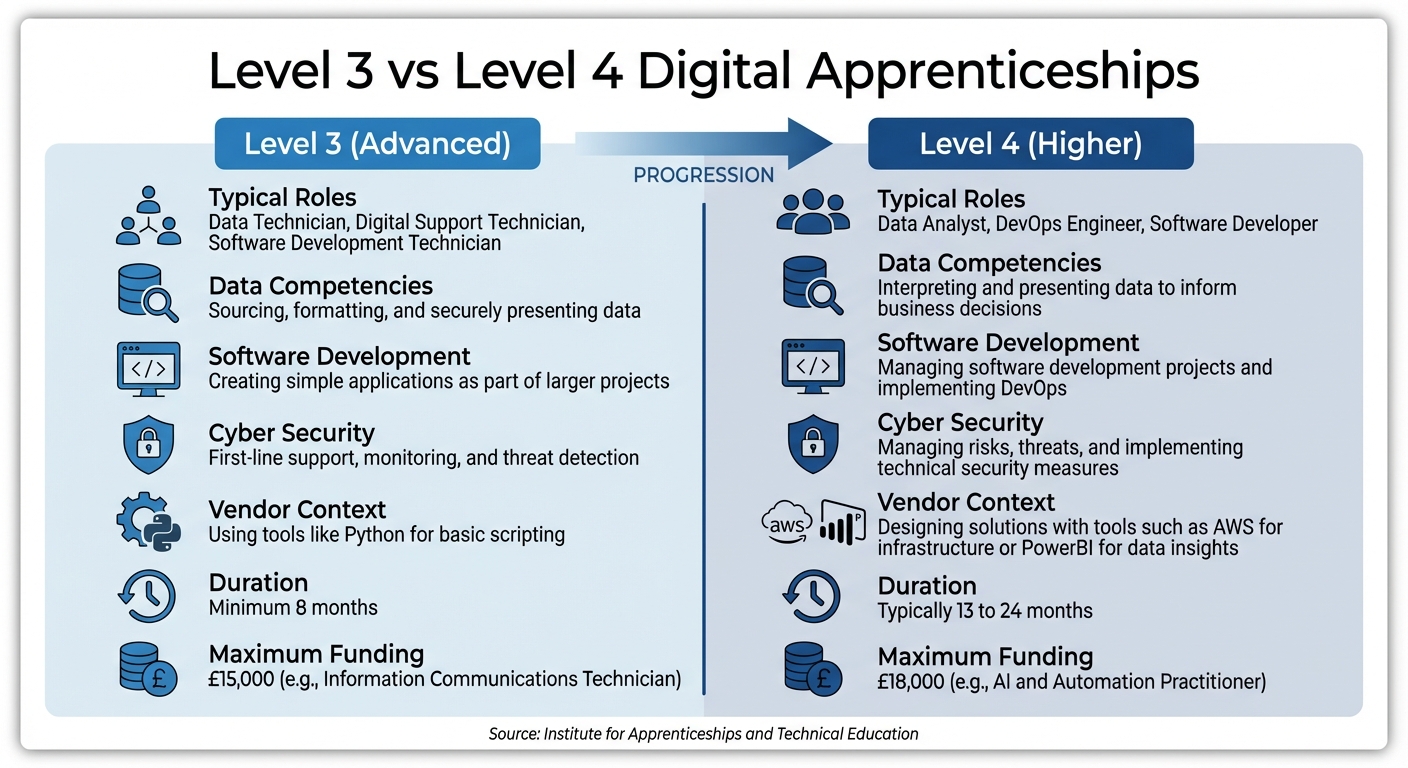
Level 3 vs Level 4 Digital Apprenticeships Comparison
Benefits of Vendor Certifications
To keep digital apprenticeships aligned with industry needs, vendor certifications and structured knowledge modules play a crucial role alongside the rigorous EPA processes and external quality checks. Certifications from providers like Microsoft, AWS, and Python are integral to these programmes, ensuring apprentices gain the skills demanded by the Institute for Apprenticeships and Technical Education. These qualifications bridge the gap between theory and practice, equipping apprentices with hands-on skills they can apply immediately.
Certifications in areas like cloud architecture, digital office tools, and productivity software empower apprentices to handle tasks such as "preparation for new or changed services", managing the "operation of the change process", and "maximising the effective use" of tools for business communication and operations. For apprentices at Level 4 and beyond, the expectation shifts to providing "tactical advice, training and support on core technology applications", a responsibility that benefits greatly from vendor-specific expertise.
These certifications are tailored to specific job roles. For instance, qualifications in cloud services and data storage prepare apprentices for roles like IT Technical Salesperson or Network Engineer, enabling them to "design, install, configure and maintain" communication networks that meet industry standards. The Department for Education underscores that apprenticeships must "give each apprentice substantial training and introduce new knowledge, skills, and behaviours in their occupation".
Level 3 vs Level 4 Standards in Digital Apprenticeships
Vendor-backed certifications also help differentiate between Level 3 and Level 4 digital apprenticeship standards, making it easier for employers and apprentices to choose the right pathway. Level 3 programmes focus on technical support and task execution, while Level 4 apprenticeships delve into analysis, design, and implementation. The minimum duration for new apprenticeship starts is 8 months.
| Feature | Level 3 (Advanced) | Level 4 (Higher) |
|---|---|---|
| Typical Roles | Data Technician, Digital Support Technician, Software Development Technician | Data Analyst, DevOps Engineer, Software Developer |
| Data Competencies | Sourcing, formatting, and securely presenting data | Interpreting and presenting data to inform business decisions |
| Software Development | Creating simple applications as part of larger projects | Managing software development projects and implementing DevOps |
| Cyber Security | First-line support, monitoring, and threat detection | Managing risks, threats, and implementing technical security measures |
| Vendor Context | Using tools like Python for basic scripting | Designing solutions with tools such as AWS for infrastructure or PowerBI for data insights |
| Duration | Minimum 8 months | Typically 13 to 24 months |
| Maximum Funding | £15,000 (e.g., Information Communications Technician) | £18,000 (e.g., AI and Automation Practitioner) |
The Institute for Apprenticeships and Technical Education highlights that "Digital and technical teams use modern or cutting-edge technology to deliver great products for users and create value for their businesses". This underscores the importance of vendor certifications in shaping the skills of apprentices at both levels.
Continuous Improvement in Programme Delivery
Monitoring and Feedback Mechanisms
Tripartite reviews, conducted every 8–12 weeks, bring together providers, employers, and apprentices to assess progress and fine-tune training plans as needed. These regular meetings act as an early-warning system, addressing potential issues before they become major problems.
To ensure accountability, the Department for Education employs the Apprenticeship Training Provider Accountability Framework, which uses specific performance indicators to evaluate providers. A provider may be flagged as "at risk" if achievement rates fall below 50%, retention drops under 52%, or withdrawals exceed 20%. Additionally, providers receiving an average feedback score of less than 2.5 out of 5 from apprentices or employers are categorised as "needs improvement". These benchmarks push providers to maintain consistent quality.
Feedback is gathered through apprentices’ "My apprenticeship" accounts and standardised questionnaires for employers. Providers can access detailed feedback, including single-year and five-year average scores, via their Apprenticeship Service accounts. This data allows them to identify and address specific areas needing attention.
High-performing providers take it a step further by conducting component-level analysis at both the standard and End-Point Assessment levels. They collaborate with End-Point Assessment Organisations (EPAOs) to enhance training methods based on how apprentices perform in their final assessments. To keep up with industry developments, teaching staff participate in continuous professional development (CPD) programmes, ensuring they stay current with new technologies and online learning techniques.
These robust feedback systems create a foundation for adapting to industry shifts and improving programme delivery.
Emerging Practices in Digital Apprenticeships
The digital apprenticeship sector is evolving quickly to keep pace with industry demands. Starting 1 August 2025, the minimum duration for new apprenticeship programmes will be reduced to 8 months, down from the current 12-month requirement. This change reflects a shift towards more flexible, skill-oriented training tailored to the fast-changing digital landscape.
Foundation apprenticeships, introduced in April 2025, provide Level 2 entry routes in software and data for young individuals without prior qualifications. To allow time for fine-tuning these new programmes, their achievement rates during the 2025–2026 academic year will not be included in a provider’s official Qualification Achievement Rate (QAR).
The Department for Education has also rolled out benchmarked QAR data, enabling providers to measure their performance against national averages. Through the Accountability Framework dashboard, providers can see how their outcomes compare with those of 25%, 50%, or 75% of other organisations.
Digital apprenticeships are increasingly incorporating cutting-edge technologies into their training. For example, new standards like the "Artificial intelligence (AI) and automation practitioner" (Level 4), approved in December 2025, and the "Machine learning engineer" (Level 6), approved in December 2024, demonstrate how the sector is responding to emerging industry needs. In specialised areas such as Digital Forensics, apprentices are also being equipped with wellbeing tools and resilience training to help them handle challenging digital data.
Providers like NowSkills are raising the bar by combining these review mechanisms with hands-on, practical training. Their programmes leverage AI tools and data analytics while maintaining consistent off-the-job training and regular progress assessments, ensuring apprentices are well-prepared for the demands of the digital sector.
Conclusion
Key Takeaways
Quality standards ensure apprentices develop the critical skills needed to thrive in their roles. These standards are crafted collaboratively by employers through trailblazer groups, ensuring they meet the actual demands of the digital sector.
The End-Point Assessment (EPA) acts as an independent measure to confirm an apprentice’s readiness for their career. Conducted by approved organisations and regulated by Ofqual, the EPA ensures assessments are fair, valid, and consistent. As Ian Bauckham, Chief Regulator at Ofqual, highlights:
It is crucial, therefore, that the assessment tests the right things in the right way, to demonstrate occupational competence.
In addition to the EPA, external quality assurance systems maintain these standards over time, while vendor certifications can provide added value in specialised areas. Recent reforms have simplified grading systems, strengthening both the clarity and rigour of competency assessments. Regular progress reviews, conducted every 8 to 12 weeks and supported by the Department for Education’s Accountability Framework, help providers maintain high achievement rates and address feedback efficiently. These combined efforts validate the learning process and ensure it translates into practical skills, enabling training providers to deliver meaningful results.
Together, these initiatives help apprentices gain the hands-on expertise needed to support the digital sector in adapting to rapid technological advancements.
How NowSkills Supports Quality Standards
Building on this robust quality framework, training providers play a key role in turning these standards into actionable outcomes.
NowSkills offers accredited digital and IT apprenticeships that align with UK quality standards, adhering to employer-defined occupational benchmarks in areas like Digital Marketing, IT Infrastructure, Content Creation, and Data Analytics. This ensures apprentices are fully prepared to meet workplace demands.
From the outset, NowSkills integrates EPA preparation into its programmes, conducts thorough initial assessments to personalise learning plans, and guarantees that full-time apprentices receive the mandatory 6 hours per week of off-the-job training. Their teaching teams undergo regular professional development to stay current with emerging technologies such as AI and data analytics. Additionally, frequent tripartite reviews ensure apprentices remain on track to successfully pass their gateway assessments.
Supported by government-funded training and strong employer collaborations, NowSkills blends expert instruction with practical, real-world experience. This approach not only meets regulatory expectations but also equips apprentices with the skills they need to build lasting careers in the fast-evolving digital landscape.
FAQs
How do employer-led standards shape digital apprenticeships?
Employer-led standards play a key role in shaping digital apprenticeships. Since these standards are developed and reviewed by employers, they reflect the actual skills required across industries. They define the knowledge, skills, and behaviours (KSBs) apprentices need to demonstrate, ensuring training is directly aligned with job roles such as digital marketing, IT infrastructure, and data analytics.
To keep up with evolving technology and industry demands, these standards are updated regularly. This ensures that training providers like NowSkills can offer government-approved programmes that stay relevant to the industry. As a result, apprentices are equipped with the skills they need to thrive in their careers.
What is the End-Point Assessment, and how does it maintain the quality of digital apprenticeships?
The End-Point Assessment (EPA) plays a key role in maintaining the high standards of digital apprenticeships. This independent evaluation ensures apprentices have fully developed the knowledge, skills, and behaviours required by their specific apprenticeship standard.
The EPA often includes a mix of assessment methods, such as reviewing a portfolio of work, completing a practical project, obtaining an employer reference, and participating in an interview. Accredited organisations carry out these assessments, ensuring they are thorough and consistent across the industry.
This structured process safeguards the quality of digital apprenticeships, equipping learners with the expertise they need to excel in their chosen careers.
Why are vendor certifications important in digital apprenticeships?
Including well-known vendor certifications in digital apprenticeships sets a clear industry standard and boosts an apprentice’s job prospects. Certifications from organisations like Microsoft, Cisco, or Google show that an apprentice has mastered up-to-date, vendor-approved skills – something employers value highly. These certifications also ensure that the apprenticeship aligns with the UK’s quality standards for sector-specific qualifications.
By incorporating vendor-backed certifications, the curriculum stays in step with rapidly changing technology, ensuring apprentices develop relevant and sought-after skills. For employers, this translates into hiring apprentices who come equipped with proven expertise, making it easier to evaluate their abilities and integrate them into permanent roles.
At NowSkills, these certifications are woven into government-funded, accredited digital and IT apprenticeships. This approach ensures apprentices earn qualifications that are recognised both nationally and globally. The result? Apprentices gain a solid foundation for career growth, while employers benefit from a stronger, more skilled talent pool.


